
Most of the time, a heat pump that feels like it's blowing cold air in winter is working normally. Two harmless explanations cover the majority of cases. First, heat pump air is simply cooler than furnace air. It usually leaves the vents somewhere in the 85–110°F range, and anything below skin temperature can feel cool on your hand. Second, the system may be in defrost mode, a routine cycle that briefly reverses the unit to melt frost off the outdoor coil. During those few minutes, the air at the vents can feel cool or lukewarm.
It's a real problem when the cool air doesn't let up. If the house keeps losing ground, the outdoor unit stays encased in ice, the system runs nonstop without reaching the thermostat setting, or the air stays cold long after any defrost should have ended, something needs attention. The usual causes are, roughly from easiest to hardest: a wrong thermostat setting, a tripped breaker or clogged filter, a blocked or iced outdoor unit, duct leaks, and then technician-level faults such as a low refrigerant charge (from a leak), a stuck reversing valve, or a failed defrost control.
This guide explains why heat pump air feels different, what defrost looks and sounds like, which checks you can safely make yourself, how auxiliary and emergency heat fit in, and where the line falls between a homeowner fix and a call to a certified technician.
The Difference in "Feel" Between a Heat Pump and a Traditional Furnace
That phrasing comes straight from a heading on one of the top-ranking pages for this question, and it's the right place to start, because many "cold air" complaints are really this.
A gas furnace makes heat by burning fuel, so the air coming off its heat exchanger is very hot. A heat pump doesn't burn anything. It moves heat from outdoors to indoors, and the air it delivers is noticeably cooler. Carrier's troubleshooting page on a heat pump not heating puts typical heat pump supply air at around 85–100°F, compared with roughly 120–140°F from a gas furnace. Energy Vanguard, a building-science firm, reports a similar range in its piece on whether heat pump supply air is too cold: about 90–110°F from a heat pump versus about 125°F from a furnace.
Your skin sits in the low 90s, so air at 90°F can feel neutral or even slightly cool when it's blowing across your hand, especially with moving air and a bit of evaporation on your skin. That doesn't mean the system isn't heating. A heat pump makes up for its lower air temperature by moving more air for longer. Energy Vanguard's point is that heating depends on how much heat gets delivered, not how hot the air feels at one register.
The practical differences you'll notice:
- Longer run times. Heat pumps often run for long stretches at a steady output instead of blasting hot air in short bursts. A Department of Energy homeowner guide for newly installed air-source heat pumps describes them as delivering a gentle, consistent flow of warm air and operating best when running continuously.
- Cooler air on colder days. A heat pump's supply air drops as the outdoor temperature drops, because there is less heat available outside to move indoors.
- No blast of hot air. If you're used to a furnace, the absence of that blast can feel like something's wrong. Usually nothing is.
Quick test: If the house is holding its thermostat setting, the system is heating, even if the vent air feels cool on your hand.
How a Heat Pump Pulls Heat Out of Cold Outdoor Air
It helps to know what the system is doing, because the same mechanism explains both defrost and the harder failures.
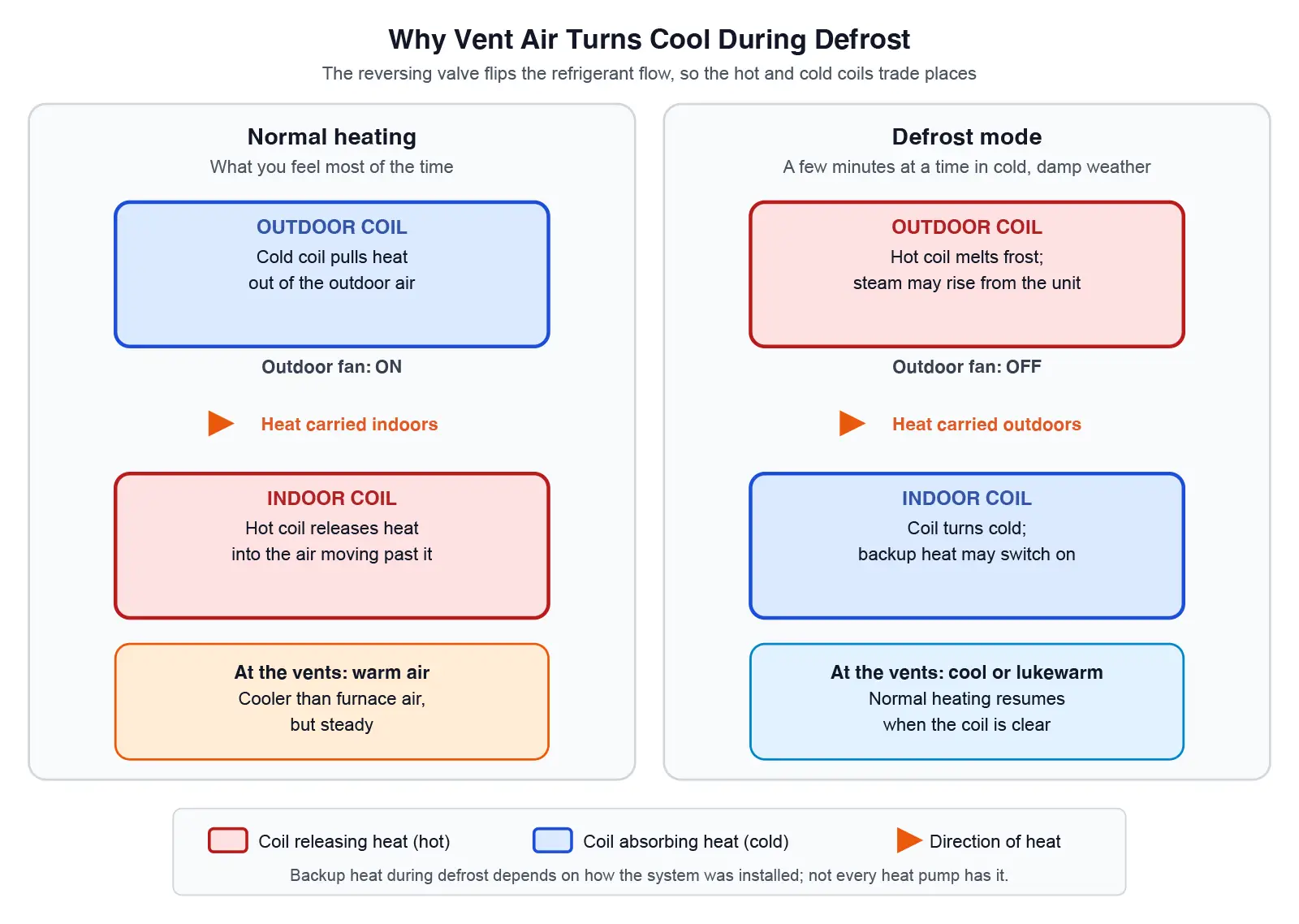
A heat pump is an air conditioner that can run in reverse. In summer, refrigerant absorbs heat indoors and releases it outdoors. In winter, a component called the reversing valve, a switching valve near the compressor, flips the direction of refrigerant flow. The outdoor coil becomes the cold coil that absorbs heat, and the indoor coil becomes the hot coil that releases it. The Department of Energy's overview of air-source heat pumps describes it plainly: in heating mode, liquid refrigerant in the outside coil removes heat from the air and evaporates into a gas.
It seems odd that there's heat to collect in 30°F air, but the refrigerant in the outdoor coil runs much colder than the air around it, and heat always moves from warmer to colder. The refrigerant boils as it absorbs that heat, the compressor raises its pressure and temperature, and the indoor coil releases the heat into your home. If you want the full step-by-step version of that cycle, see how refrigerants transfer heat inside an air conditioner. A heat pump runs the same loop in the other direction.
Two consequences matter for troubleshooting:
- The colder it gets outside, the less heat the system can gather. Supply air cools and run times lengthen as temperatures fall.
- The outdoor coil runs below freezing in cold weather, so moisture in the air freezes onto it as frost. That frost has to be cleared, which is what defrost mode is for.
Defrost Mode: The Most Common "Cold Air" That Isn't a Problem
If the cool air comes and goes, lasting a few minutes before normal heat returns, defrost is the most likely explanation.
As frost builds on the outdoor coil, it blocks airflow and cuts the unit's ability to absorb heat. To clear it, the control board temporarily switches the heat pump into cooling mode. The DOE overview notes that the reversing valve changes the refrigerant flow both for cooling and for defrosting the outdoor coil in winter. Hot refrigerant is sent to the outdoor coil to melt the frost, and for those minutes the indoor coil turns cold.
What you may notice during defrost:
- Cool or lukewarm air at the vents for a short period
- A whoosh or clunk as the reversing valve shifts, sometimes followed by a quieter period
- The outdoor fan stopping while the coil heats up
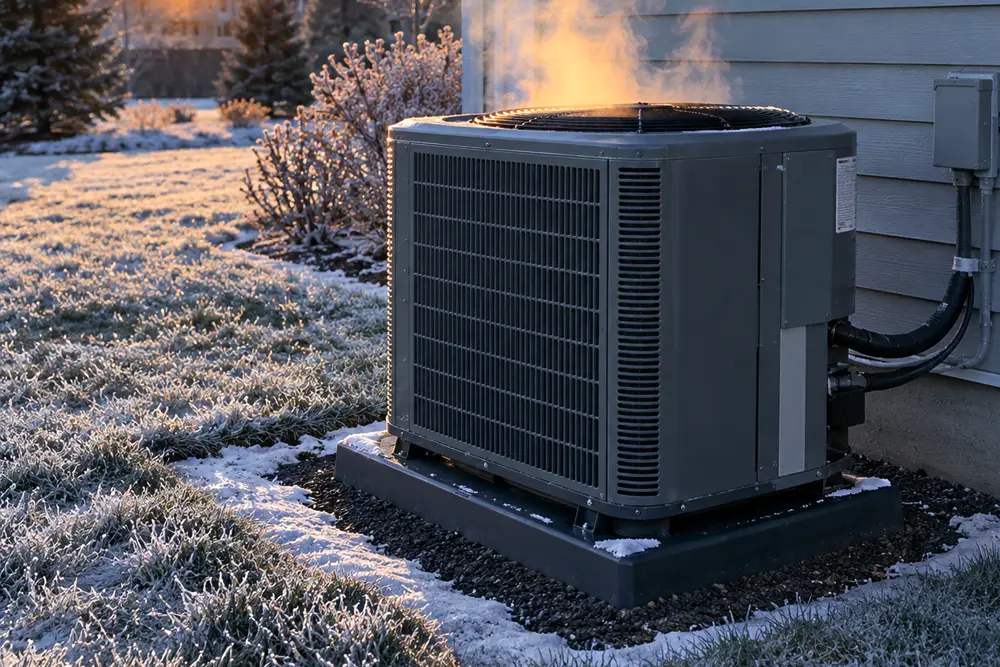
- Steam rising from the outdoor unit, which is meltwater evaporating off a warm coil, not smoke
- Backup heat briefly coming on, if your system is set up to temper the air during defrost
How long it lasts depends on the equipment. Carrier gives about 5–10 minutes for a typical defrost cycle. Lennox's guide to a heat pump blowing cold air gives 5–15 minutes, and the DOE homeowner guide says it typically takes 5 to 15 minutes. How often it happens also varies. Lennox notes that some units defrost on demand when sensors detect frost, while others run on fixed timer intervals of 30, 60, or 90 minutes. The DOE recommends choosing a heat pump with demand-defrost control, because it minimizes unnecessary defrost cycles.
Defrost is more frequent in cold, damp weather, when temperatures hover around freezing with high humidity, because that's when frost forms fastest. A few defrost cycles an hour on a raw, wet day can be normal. A unit that seems to be defrosting constantly, or one that stays iced over afterward, is not.
Check These First: Thermostat, Breaker, and Filter
Carrier lists the most common reasons a heat pump isn't heating as an incorrect thermostat setting, a tripped circuit breaker, or a dirty air filter. All three are safe for a homeowner to check, and together they take about ten minutes.
Thermostat settings
- Mode set to Heat. Lennox points out that if the thermostat is set to "Cool" instead of "Heat," the air moving through your vents won't be warm. Settings get changed accidentally, especially after a power outage, battery change, or seasonal switchover.
- Fan set to Auto, not On. With the fan on "On," the blower runs even when the heat pump isn't heating, including between cycles, so you feel room-temperature air moving that seems cold. "Auto" runs the fan only during a heating call.
- Setpoint above room temperature. It sounds obvious, but a setback schedule may have lowered it.
- Batteries and display. A dim or blank display can cause erratic behavior.
Breaker and disconnect
Many heat pump systems have more than one circuit: one for the outdoor unit and one for the indoor air handler or furnace, and sometimes another for backup heat strips. If the indoor blower runs but the outdoor unit is silent, check the breaker panel and the outdoor disconnect box near the unit. Reset a tripped breaker once. If it trips again, stop and call a technician; repeated tripping points to an electrical fault.
Air filter
A clogged filter chokes airflow across the indoor coil, which lowers heat output and can make the system overheat or short-cycle. The DOE's guide to operating and maintaining your heat pump recommends cleaning or changing filters every three months, or as the manufacturer or installer recommends. Its newer-heat-pump guide says ductless indoor units should have their filters cleaned at least monthly. If you can't see light through your filter, change it now.
Heat Pump Not Working in Cold Weather: When the Outdoor Unit Can't Keep Up
That exact heading appears on Carrier's page, and it describes the situation homeowners find most confusing: nothing seems broken, but the house won't stay warm on the coldest days.
Because a heat pump gathers heat from outdoor air, its capacity falls as outdoor temperatures fall, while your home loses heat faster at the same time. At some temperature, the balance point, the heat pump alone can no longer keep up. Below that point, a correctly set-up system turns on its backup heat, usually electric resistance strips in the air handler or, on dual-fuel systems, a furnace.
Whether your system reaches that point depends on what you have. Older and standard heat pumps lose capacity quickly in deep cold. Cold-climate heat pumps are built to keep working at much lower temperatures. The DOE notes that air-source heat pump technology has advanced to the point of being a legitimate space-heating option in colder regions. If your system is a standard model in a cold climate, a few weeks each winter of long run times and backup heat may simply be how it was designed to operate.
The signs that point to a problem instead:
- The house falls well below the setpoint and doesn't recover, even with backup heat available.
- The backup heat indicator stays on for long periods in mild weather.
- The outdoor unit is running, but the large insulated copper line near it isn't warm to the touch in heat mode.
The DOE guide for newly installed systems adds a useful warning: auxiliary heating is costly and inefficient, and if you see it running frequently, have a professional make sure the unit is working properly.
Auxiliary Heat vs. Emergency Heat
Two thermostat labels confuse almost every new heat pump owner, and mixing them up can cost real money.
| What it's called | What it does | Who turns it on |
|---|---|---|
| Auxiliary heat ("AUX") | Backup heat that runs alongside the heat pump when it can't keep up, or during defrost | The system, automatically |
| Emergency heat ("EM HEAT") | Shuts the heat pump off and heats the house with the backup source only | You, manually, at the thermostat |
Source: Lennox, "What is Emergency Heat and When to Use It?"
Lennox's explainer on emergency heat makes the key distinction: auxiliary heat works alongside your heat pump, while emergency heat shuts the heat pump off completely and runs only the backup source. In most homes that backup is electric resistance heat. Lennox compares it to a space heater or toaster and notes it's less efficient than the heat pump, so bills can climb quickly if emergency heat runs for days or weeks.
Seeing "AUX" light up on a very cold morning or during defrost is normal. Seeing it lit most of the time in 45°F weather is a reason to call a technician.
Should I Switch to Emergency Heat When It's Super Cold Outside?
A related search result asks this almost word for word. For most homes the answer is no, because the system already brings in backup heat automatically when it needs to. Switching to emergency heat just because it's cold turns off your most efficient heat source and runs only the expensive one.
Lennox lists three situations when emergency heat is appropriate:
- An HVAC technician tells you to use it.
- Your heat pump has completely failed.
- The outdoor unit is frozen or damaged.
Think of emergency heat as a way to keep the house warm while you wait for a repair. If you switch to it, schedule the service call the same day. Don't leave it on longer than you need to.
The same logic applies to temperature setbacks. The DOE advises against setting back a heat pump's thermostat if doing so causes backup heating to come on, since backup systems are usually more expensive to run. Its newer-installation guide suggests avoiding abrupt changes of 3°F or more during unoccupied hours, and notes that setbacks typically save energy only when you're away more than a day. Big overnight setbacks can backfire: the morning recovery calls for backup heat, and the air feels cold while the heat pump works to catch up.
Ice on the Outdoor Unit: Normal Frost or a Problem?
It's normal for a winter heat pump to have some frost on it. It isn't normal for it to be encased in ice.
Carrier draws the line clearly: ice thicker than about a quarter inch, or ice that remains after defrost, isn't normal and may indicate restricted airflow, low refrigerant, or a defrost-system problem.
| What you see | Usually means | What to do |
|---|---|---|
| Light, even frost that clears periodically, with steam | Normal frosting and defrost | Nothing |
| Snow drifted against the coil or piled on top | Blocked airflow | Gently clear snow by hand or broom; never chip at the coil |
| Ice sheet from roof dripping onto the unit | Water source above the unit | Fix the gutter or add a snow shield; ask a pro to thaw the unit |
| Thick ice that stays after defrost | Defrost failure, low charge, or restricted airflow | Switch to emergency heat and call a technician |
| Ice on only part of the coil | Often a refrigerant or airflow problem | Call a technician |
Sources: Carrier heat pump troubleshooting guidance; DOE air-source heat pump homeowner guide.
On placement, the DOE homeowner guide recommends shielding the unit from water and snow coming off the roof. It suggests locations on the home's gable end, fully under the eave, beneath a deck, or protected by a snow shield. The DOE also recommends clearing vegetation and clutter from around the outdoor unit, with the power to the fan turned off.
Never pour hot water on the coil or chip at the ice. The fins are thin aluminum and bend easily, and the refrigerant tubing underneath can be punctured.
Low Refrigerant, a Stuck Reversing Valve, and Other Problems That Need a Technician
If the simple checks don't explain the cold air, the cause is usually inside the sealed system or the controls. That's technician territory. Knowing the likely culprits helps you describe what you're seeing and understand the diagnosis.
| Symptom | Likely cause | Who handles it |
|---|---|---|
| Cools fine in summer, blows cool air in heat mode | Reversing valve stuck or its solenoid failed | Technician |
| Weak heat, long run times, frosting in patches | Low refrigerant charge from a leak | Certified technician: leak search, repair, recharge |
| Outdoor unit ices up and never clears | Defrost board, sensor, or outdoor fan fault | Technician |
| Indoor fan runs, outdoor unit silent | Tripped breaker, failed capacitor or contactor, compressor problem | Check breaker once; then technician |
| Air cold in some rooms, fine in others | Duct leaks, disconnected ducts, closed dampers | Check registers; duct repair by a pro |
| AUX runs constantly in mild weather | Heat pump not producing heat, or thermostat misconfigured | Technician |
A few of these deserve a closer look.
The reversing valve
Carrier gives a telling clue: if your heat pump isn't heating but works perfectly in cooling mode, the reversing valve may be stuck. The valve is what switches the system between heating and cooling, so a valve stuck in its cooling position leaves you with cool air in heat mode. Sometimes the fault is electrical, in the solenoid coil or the control signal, which is a relatively simple fix. Sometimes the valve body itself has failed. Replacing it means opening the sealed refrigerant system, which is a much bigger job.
Low refrigerant
Lennox puts it simply: refrigerant carries heat from outside to inside, and if there's a leak or the levels are low, the heat pump can't transfer enough warmth. Keep in mind that refrigerant isn't used up. A heat pump that's low has a leak. Adding refrigerant without finding and fixing the leak buys you time, not a repair. The DOE's maintenance checklist says a technician should verify the correct refrigerant charge by measurement and check for leaks. A charge guessed at by feel doesn't count.
Defrost controls
If defrost never starts, the coil ices over and heat output collapses. If defrost gets stuck on, you get long stretches of cold air indoors. Either way the fix is usually a sensor, a defrost board, or the outdoor fan motor. All three are technician diagnoses.
Duct and Airflow Problems That Make Warm Air Feel Cold
Sometimes the heat pump is fine and the heat is getting lost between the equipment and the register.
Carrier notes that in a typical home, about 20–30% of the air moving through the duct system can be lost through leaks, holes, and poorly connected ducts. When ducts run through an unheated attic or crawlspace in winter, that loss is especially costly. Air that left the air handler warm can cool noticeably on its way to a far room. A duct that has come loose can dump warm air into the attic and leave one room with barely anything.
Register placement matters too. Energy Vanguard's advice for heat pump systems is simple: "Don't blow air on people." Air around 95°F aimed straight at a couch or bed will feel drafty even while the room is warming properly. Adjusting registers so air sweeps along walls and ceilings instead of across seating often fixes a "cold air" complaint without touching the equipment.
Things you can check:
- Make sure supply registers are open and not blocked by furniture or rugs.
- Make sure return grilles are unobstructed.
- Look for obviously disconnected or crushed ducts where they're visible in the basement or attic.
Sealing and repairing ducts is a professional job, and often a worthwhile one.
What a Service Call for "Cold Air" Should Look Like
Knowing the usual order of a diagnosis helps you judge whether you're getting one. A thorough technician typically works through it in this order:
- Confirm the complaint. They'll check thermostat mode, fan setting, setpoint, and configuration (including whether the thermostat is set up for a heat pump with the right backup heat staging).
- Check airflow. That means the filter, blower, indoor coil, and registers.
- Inspect the outdoor unit. They'll look at fan operation, coil condition, ice pattern, and clearance.
- Check electrical components. Capacitors, contactors, and the voltage to the outdoor unit.
- Test the reversing valve and defrost controls. This includes forcing a defrost cycle to confirm it starts and ends.
- Measure the refrigerant circuit. They'll connect gauges and temperature probes, compare readings with the manufacturer's charging data, and search for leaks if the charge is low.
- Check backup heat. They'll confirm the auxiliary heat stages and emergency heat work as intended.
Good questions to ask at the end: What did you measure? Where is the leak, if there is one? What happens if I wait until spring? If you get a diagnosis without numbers, especially "it just needs a little refrigerant," ask for more detail.
Can I Add Refrigerant to My Heat Pump Myself?
No, and the federal rule on this is clear.
The EPA's refrigerant sales restriction limits refrigerant purchases to Section 608 certified technicians (for stationary equipment like home heat pumps), Section 609 certified technicians (for motor vehicle air conditioning), and employers of certified technicians who provide written evidence of that employment. The restriction covers the HFC refrigerants in modern heat pumps. The only consumer exception is small cans for DIY car air conditioning, which doesn't apply to a home system. Beyond the legal limit, charging a heat pump correctly depends on measurements, the manufacturer's charging data, and in many cases proper weighing. An overcharged or undercharged heat pump heats poorly and wears out its compressor faster.
What you can usefully do is find out which refrigerant your heat pump uses. It's printed on the outdoor unit's data plate. Many heat pumps installed over the past couple of decades use R410A. Newer equipment from major manufacturers commonly uses R454B or R32. Some very old units still run on R22. Knowing the type tells you what your technician will need. Your technician can then confirm current availability and cylinder size before ordering, so a repair visit isn't delayed by a second trip. For what refrigerant a system of your age most likely uses, see recommended refrigerants by air conditioner age. The same eras apply to heat pumps.
Never let anyone add a different refrigerant to "top off" your system. Refrigerants aren't interchangeable, and mixing them makes a system impossible to diagnose and service properly.
Repair or Replace? Making the Call for Your Household
When the diagnosis comes back as a leak, a failed reversing valve, or a compressor problem, the repair-versus-replace question follows. Weigh it the way you'd weigh any large household expense:
- Age and condition. A young heat pump with a single failed part is almost always worth repairing. An old unit with a second major sealed-system repair in a few years deserves a replacement quote.
- Type of repair. Electrical parts and controls are relatively inexpensive. Sealed-system work, such as a reversing valve or a compressor, costs much more, because it means recovering refrigerant, brazing, evacuating, and recharging.
- Refrigerant. A heat pump on R22 depends on a refrigerant that is no longer produced. Heat pumps on R410A remain serviceable, but they're part of a supply that keeps shrinking under the federal HFC phasedown. For how that affects older equipment, see which refrigerants are being phased down in the United States.
- Comfort history. If the house has never been comfortable in deep cold, a replacement is a chance to choose a cold-climate model or fix duct problems at the same time.
Ask for both options in writing: the repair with its expected life, and the replacement with its equipment details. Compare them over the years you plan to stay in the home.
Frequently Asked Questions
Why is my heat pump blowing cold air?
Most often it's normal defrost mode or simply cooler supply air than a furnace produces. If the cool air persists, check the thermostat (Heat, fan on Auto), the breaker, and the filter. If none of those explain it, call a technician to check the reversing valve, defrost controls, and refrigerant charge.
Is it normal for a heat pump to blow cool air during defrost?
Yes. During defrost the system briefly reverses to melt frost off the outdoor coil, so the indoor coil turns cool for a few minutes. Manufacturers describe typical defrost cycles as lasting about 5–15 minutes.
Why does my heat pump steam in winter?
That's meltwater evaporating off the warm outdoor coil during defrost. It's normal and it isn't smoke.
How warm should heat pump air feel?
Typical heat pump supply air runs roughly 85–110°F, cooler than a gas furnace's roughly 120–140°F. Because that's close to skin temperature, it can feel lukewarm even when the system is heating normally.
Should I use emergency heat when it's very cold outside?
Usually not. The system brings on auxiliary heat automatically when needed. Use emergency heat only when a technician tells you to, when the heat pump has failed, or when the outdoor unit is frozen or damaged, and only until the repair.
Why is my heat pump running constantly in winter?
In very cold weather, long run times can be normal, since heat pumps are designed to run steadily. If it can't hold the setpoint, if AUX heat runs constantly in mild weather, or if the outdoor unit ices up, have it checked.
Can low refrigerant make a heat pump blow cold air?
Yes. Without enough refrigerant the system can't carry enough heat indoors. Low refrigerant means a leak, and fixing it takes a certified technician who locates the leak, repairs it, and recharges by measurement.
Is it safe to keep running a heat pump that's blowing cold air?
If it's defrost or cooler supply air, yes. If the outdoor unit is encased in ice, breakers keep tripping, or you hear grinding or loud clanking, switch to emergency heat or turn the system off and call for service. Running a failing unit can turn a small repair into a compressor replacement.
Conclusion
A heat pump that feels like it's blowing cold air in winter is usually doing one of two normal things: delivering gentler air than a furnace, or clearing frost in a short defrost cycle. The checks that solve most real problems are ones you can do yourself: thermostat mode and fan setting, breakers, filter, and snow or ice around the outdoor unit. Past that, the causes are inside the sealed system or the controls: a stuck reversing valve, a defrost failure, or a refrigerant leak. Those call for a certified technician who measures before recommending a fix.
Know the difference between auxiliary and emergency heat, avoid big thermostat setbacks, and keep the outdoor unit clear. Most homeowners who do those things find that their heat pump's "cold air" was normal operation all along.