
Refrigerant usually shows up on an HVAC invoice in two ways. There's the refrigerant itself, billed by the pound at an installed price that includes the contractor's cost and markup. Then there's the labor around it: finding a leak, recovering refrigerant already in the system, pulling a vacuum, and weighing in a new charge. A fair invoice names the refrigerant type (R410A, R22, R32, or R454B), states the number of pounds added, and prices that refrigerant within published ranges. For 2026, Angi puts R410A at about $40–$75 per pound, and Trane's pricing guide gives $40–$90 per pound installed.
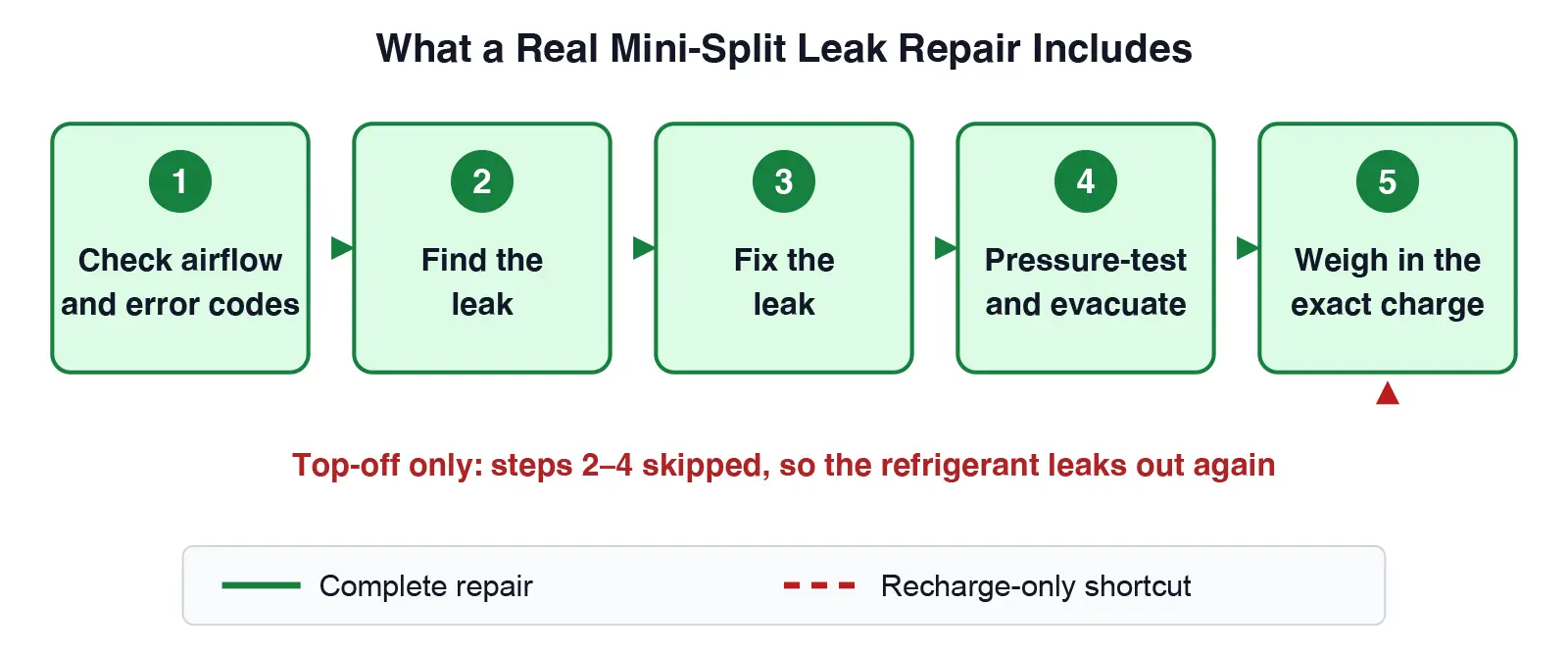
Before you judge any single line, check one thing: did the work include finding and fixing a leak, or only adding refrigerant? Refrigerant doesn't get used up, so a system that needs refrigerant has a leak or was undercharged at installation. An invoice that shows pounds of refrigerant and no leak diagnosis usually means you'll be paying for the same refrigerant again. The rest of this guide goes through each refrigerant-related line you're likely to see, what's normal in 2026, and the questions that separate a fair bill from a padded one.

The Refrigerant Line Items You're Likely to See
Contractors word these differently, but most residential invoices that involve refrigerant use some version of the lines below.
| Invoice line | What it should cover | Typical 2026 range | What to ask |
|---|---|---|---|
| Service call / diagnostic | Trip plus initial troubleshooting | $75–$200 | Is it credited toward the repair? |
| Leak search / leak detection | Locating where refrigerant escaped | About $100–$450 | Where was the leak found? |
| Refrigerant, per lb | The refrigerant added, installed | Varies by type (see below) | Which refrigerant, and how many pounds? |
| Recharge (flat rate) | Labor and refrigerant as one line | About $150–$500 | How many pounds does that include? |
| Recovery / disposal | Removing old refrigerant before work | $30–$100 is one published range | Why was recovery needed on this job? |
| Evacuation / vacuum | Removing air and moisture before recharging | Often folded into labor | Was the system opened for repair? |
| Labor (hourly) | Technician time beyond flat-rate items | $100–$250 per hour | How many hours, doing what? |
Sources: Angi AC Freon leak repair and R410A per-pound cost guides (2026 data); HomeGuide AC Freon recharge cost guide (diagnostic and recovery fees).
Not every invoice will have every line. Many companies use flat-rate pricing, where a single "refrigerant leak repair" line bundles several of these tasks. Flat rates are normal. What you want in either format is enough detail to see what was done and how much refrigerant went in.
Why Refrigerant Is Billed by the Pound
Refrigerant is sold to contractors in cylinders by weight, and it goes into your system by weight, so pricing it per pound is the only consistent way to bill it. Your system's manufacturer specifies how much it holds, and a proper recharge puts back a measured amount.
The per-pound number on your invoice isn't the contractor's wholesale cost. It's an installed price that also covers:
- Supply cost. Refrigerant prices have climbed as the federal HFC phasedown shrinks supply. EPA's phasedown FAQ lays out a production and import cap that drops to 30% of the historic baseline from 2029. For why that matters to R410A and other common refrigerants, see which refrigerants are being phased down in the United States.
- Handling and certification. Only certified technicians can buy refrigerant for home systems. EPA's technician fact sheet states that refrigerant can only be sold to technicians certified under Sections 608 or 609.
- Partial cylinders and recovery. A contractor rarely uses a full cylinder on one house, and recovered refrigerant has to be stored and eventually sent for reclamation.
So a per-pound price several times what a cylinder costs a contractor isn't automatically a rip-off. A price far above the published installed ranges below deserves a question.
How Much Refrigerant Should a Home System Take?
This is where most homeowners lose the thread. The invoice says "6 lbs R410A," and you have no idea whether that's a little or a lot.
Two published reference points help. Trane's AC refrigerant recharge pricing guide says systems generally hold 2–4 pounds per ton of cooling capacity. A ton is 12,000 BTU per hour, and residential systems commonly run from about 1.5 to 5 tons. Angi's R410A cost-per-pound guide uses the same rule of thumb for its full-recharge estimates:
| System size | Example full charge used by Angi | Full R410A recharge estimate |
|---|---|---|
| 2 tons | 6 lbs | $360–$570 |
| 3 tons | 9 lbs | $480–$800 |
| 4 tons | 12 lbs | $600–$1,000 |
| 5 tons | 15 lbs | $720–$1,250 |
Source: Angi, "How Much Does R-410A Refrigerant Cost per Pound?" (2026 data). These are full-recharge estimates; a top-up after a small leak uses less.
Your own system's number is more precise than any rule of thumb, and it's printed on the outdoor unit. The data plate lists the factory charge: the weight of refrigerant the unit shipped with. That charge is sized for a standard length of copper line set between the indoor and outdoor units. Goodman's long line set application guideline states that its residential R410A outdoor units are factory charged for 15 feet of line set, with about 0.6 ounce of refrigerant added per extra foot. A system with a long run between units holds somewhat more than the plate says. Other manufacturers publish their own figures, so your technician should use your equipment's documentation.
That gives you a useful check. The pounds added on a single invoice should make sense relative to your system's total charge. A small leak might need a pound or two. A full recharge after a repair should land near the system's total charge. Adding more than the system's total charge is a red flag unless the invoice also shows the system was fully recovered and recharged.
How the Pounds on Your Invoice Are Supposed to Be Measured
A good technician doesn't guess at pounds. When a system has been repaired and evacuated, the refrigerant is weighed in: the cylinder sits on a digital charging scale, and the technician adds exactly the weight the manufacturer specifies. That weight is the number that belongs on your invoice.
When only a small amount is added to a running system, the technician adjusts the charge by measurement. They watch pressures and temperatures, including superheat (how far the vapor leaving the indoor coil has warmed past its boiling point) and subcooling (how far the liquid leaving the outdoor coil has cooled below its condensing point), and weigh what goes in. Either way, the pounds on the invoice come from a scale reading, not an estimate.
Three questions keep this honest without any technical knowledge:
- "How many pounds did you add, and was it weighed?" A technician who weighed it can answer immediately.
- "What did the superheat and subcooling read after charging?" These confirm the system is correctly charged, not just "cold."
- "What's the factory charge on my unit?" It's on the data plate, and it frames every number above.
What Refrigerant Costs Per Pound in 2026
The per-pound price depends heavily on which refrigerant your system uses, which the invoice should always name.
| Refrigerant on the invoice | Published installed price per pound | Why it costs what it does |
|---|---|---|
| R22 | About $100–$350 (Angi); $100–$250 (Trane) | No longer produced; supply is recovered and reclaimed stock |
| R410A | About $40–$75 (Angi); $40–$90 (Trane) | Common in existing systems; supply capped by the HFC phasedown |
| R32 | About $50–$80 (Angi) | Newer refrigerant in ductless and some ducted systems |
| R454B | Few published consumer benchmarks yet | Newest residential refrigerant; ask for the per-pound price in writing |
Sources: Angi, "How Much Does AC Freon Leak Repair Cost?" (2026 data); Trane, "AC Refrigerant Recharge Pricing Guide" (R22 range stated for 2025).
If you're not sure which refrigerant your system uses, it's printed on the outdoor unit's data plate. The age of the equipment also narrows it down; see recommended refrigerants by air conditioner age. An invoice that says only "Freon" or "refrigerant" without a type isn't specific enough. Ask for the exact designation.
Leak Search, Recovery, and Evacuation: The Labor Behind the Refrigerant Line
Refrigerant work isn't just pouring gas into a system. Federal rules require specific steps, and those steps show up as line items or inside flat rates.
Leak search
A leak search is the most valuable line on a refrigerant invoice, because it's the one that stops repeat bills. Technicians use electronic detectors, bubble solution, UV dye, or a nitrogen pressure test. The invoice or the technician's notes should say where the leak was: a coil, a fitting, a service valve, the line set. "Leak search performed, no leak found" followed by a recharge is possible, but it should come with a plan, such as dye added or a follow-up visit.
Trane is blunt about why this matters. It says a recharge is not part of normal maintenance, and the only reasons to need one are a refrigerant leak or a system improperly charged at installation. The mechanism is simple: refrigerant circulates in a sealed loop and isn't consumed, as explained in how refrigerants transfer heat inside an air conditioner.
Recovery
Whenever a technician opens the refrigerant circuit for a repair, whatever refrigerant is left has to come out first, and it can't be released into the air. EPA's technician fact sheet states that Section 608 of the Clean Air Act prohibits knowingly releasing refrigerant during maintenance, service, repair, or disposal. It also requires technicians to evacuate refrigerant using certified recovery or recycling equipment before opening or disposing of appliances. A "recovery" line tells you the system was opened for real repair work, which is usually a good sign.
Evacuation and vacuum
After a repair, the system is pulled into a deep vacuum to remove air and moisture before the new charge goes in. This step often doesn't get its own line and is folded into the repair labor. If your invoice shows a repair such as a coil replacement or valve replacement plus a recharge, evacuation should have happened in between. It's fair to ask.
What Is an "EPA Fee" or "Environmental Fee"?
Some invoices carry a line labeled "EPA fee," "environmental fee," or "refrigerant handling." The name can suggest a government charge. In practice it's usually the contractor's own charge for meeting refrigerant rules: owning and maintaining certified recovery equipment, storing recovered refrigerant, and sending it for reclamation or disposal instead of venting it.
These fees aren't improper in themselves. Recovery really does cost the contractor money, and HomeGuide's AC Freon recharge cost guide lists $30–$100 as one range some contractors charge to remove and dispose of R22. Two questions keep the line transparent:
- "Is this a government charge or your company's fee?" An honest answer is fine either way. You just want to know what you're paying for.
- "Was refrigerant actually recovered on this job?" A handling fee makes sense when refrigerant was removed. It makes less sense on a visit that only added refrigerant.
Recovered, Recycled, or Reclaimed Refrigerant
You may see terms like "reclaimed" or "recycled" on an invoice, especially for R22. EPA's page on recovering, recycling, and reclaiming refrigerants defines them precisely:
- Recover: remove refrigerant from an appliance and store it in an external container, without necessarily testing or processing it.
- Recycle: clean refrigerant for reuse in equipment of the same owner, without meeting all reclamation requirements.
- Reclaim: reprocess refrigerant to the full purity specifications in EPA's regulations and verify that it meets them.
Reclaimed refrigerant that meets the specification is a legitimate product, and as supplies tighten, more of it circulates, particularly for R22. What matters is that the refrigerant going into your system is the correct type and a clean product. It's reasonable to ask whether the refrigerant came from a sealed, labeled cylinder. For what a genuine sealed cylinder looks like, see how to tell if a refrigerant cylinder is factory sealed.
Red Flags on a Refrigerant Invoice
Most refrigerant invoices are fair. These patterns are the ones worth questioning before you pay.
| What you see | Why it's a concern | What to ask |
|---|---|---|
| "Freon" with no type and no pounds | You can't check the quantity or the price | Which refrigerant, and exactly how many pounds? |
| Pounds added exceed the unit's total charge | A system can't hold more than its full charge | Was the system fully recovered and recharged? |
| Second or third recharge, no leak found | You're paying repeatedly for a leak nobody fixed | Can we do a full leak search this visit? |
| Per-pound price far above published ranges | Possible overpricing, or an unusual supply situation | What's your per-pound rate, and why? |
| A different refrigerant "added" to an R22 system | Refrigerants must never be mixed | Was the old refrigerant fully removed first? |
| Repair listed, but no recovery or evacuation | Opening the system requires both | Were they included in the repair labor? |
The mixing row deserves emphasis. Some older R22 systems are converted to an alternative refrigerant. A proper conversion removes the old refrigerant completely and follows the replacement refrigerant's documented procedure, and it should be described that way on the invoice, not buried as "topped off." Adding a different refrigerant on top of what's already in the system leaves a mixture that no technician can properly diagnose or service afterward.
Do I Have to Get Refrigerant Details in Writing?
Federal rules require a refrigerant invoice for large systems, not typical homes. EPA's recordkeeping requirements say technicians servicing appliances with 50 or more pounds of refrigerant must give the owner an invoice showing the amount of refrigerant added. Most residential systems hold far less than 50 pounds, so that rule usually doesn't apply to your house.
That makes asking even more important. Reputable contractors routinely list the refrigerant type and pounds anyway, and you can request it before work starts. Keep your invoices together. Over several years they tell a story: a system that needs a few pounds every summer has a leak that's costing you more than a repair would.
A useful record for each visit includes:
- the date and the technician's company
- the refrigerant type and pounds added (or recovered)
- where any leak was found and what was done to fix it
- superheat and subcooling readings after the work, if the technician provides them
When the Refrigerant Charges Say "Replace, Don't Recharge"
Sometimes the most useful thing an invoice tells you is that it's time to stop paying for refrigerant. Trane's pricing guide ends on exactly this point: the "repair or replace" question.
The signs are usually right there in the charges:
- Repeat recharges on the same system. Each one is money spent on refrigerant that leaks out again.
- An R22 system with a large leak. At $100 or more per pound installed, a full R22 recharge can approach the cost of meaningful repairs. That's before the leak repair, on equipment that is almost certainly old.
- A leak in a major component on an older unit. Angi's 2026 leak repair data lists evaporator coil repair or replacement at $600–$2,000. On an aging system, that line item is the signal to get a replacement quote before approving it.
None of this means refrigerant charges are suspicious by default. Refrigerant is a real, rising cost, and most contractors bill it fairly. The goal is to read each line knowing what it should cover, so a repair you approve actually solves the problem.
Frequently Asked Questions
How much is R410A per pound on an HVAC invoice?
Published 2026 installed prices run about $40–$75 per pound (Angi), and Trane gives $40–$90 per pound installed. Prices vary by region and contractor.
How much is R22 per pound?
R22 is no longer produced, so it costs much more: about $100–$350 per pound installed (Angi's 2026 data) or $100–$250 (Trane's 2025 range).
How do I know I even need a refrigerant recharge?
Only if there's a leak or the system was undercharged at installation. Refrigerant isn't used up in normal operation, so a recharge without a leak diagnosis doesn't solve the underlying problem.
How much refrigerant does a home AC hold?
Roughly 2–4 pounds per ton of cooling capacity, per Trane. Your outdoor unit's data plate lists the exact factory charge, and longer line sets hold a little more.
What is an EPA fee on an HVAC invoice?
Usually the contractor's charge for recovering, storing, and disposing of refrigerant as federal rules require. Ask whether refrigerant was actually recovered on your job.
Can I buy refrigerant myself to save money?
No. Refrigerant for home systems can only be sold to Section 608 or 609 certified technicians, and charging a system correctly requires evacuation, weighing, and measurements.
Is it normal for an invoice to list a flat "recharge" price?
Yes. Many companies use flat rates, often around $150–$500 for a recharge. Ask how many pounds the flat rate includes so you can compare quotes.
The Bottom Line
The refrigerant lines on an HVAC invoice aren't hard to read once you know what each one is for. The refrigerant itself should be named and measured in pounds at a price within published ranges. The labor around it (leak search, recovery, evacuation) is what turns a recharge into a real repair. Check the pounds against your unit's data plate, ask where the leak was found, and keep your invoices over the years. That habit protects you from overpaying far better than haggling over the per-pound rate.