
Yes. R454B is safe in your home when it's installed in equipment designed and certified for it. That covers every new R454B air conditioner and heat pump sold for U.S. homes. R454B is classified A2L, which means lower toxicity and lower flammability. It won't burn unless it builds up to a high concentration in the air, it's hard to ignite, and if it does ignite it burns slowly. The equipment is built around those limits: federal rules require R454B systems to meet a specific safety standard, and many of them include a refrigerant leak sensor that switches on the blower to dilute any leak long before it could reach a flammable level.
The word "flammable" is where most of the worry comes from, and it's worth understanding precisely rather than ignoring it. What keeps you safe isn't that R454B can never burn. It's that the equipment and the installation rules keep the refrigerant from ever collecting at a concentration that could.
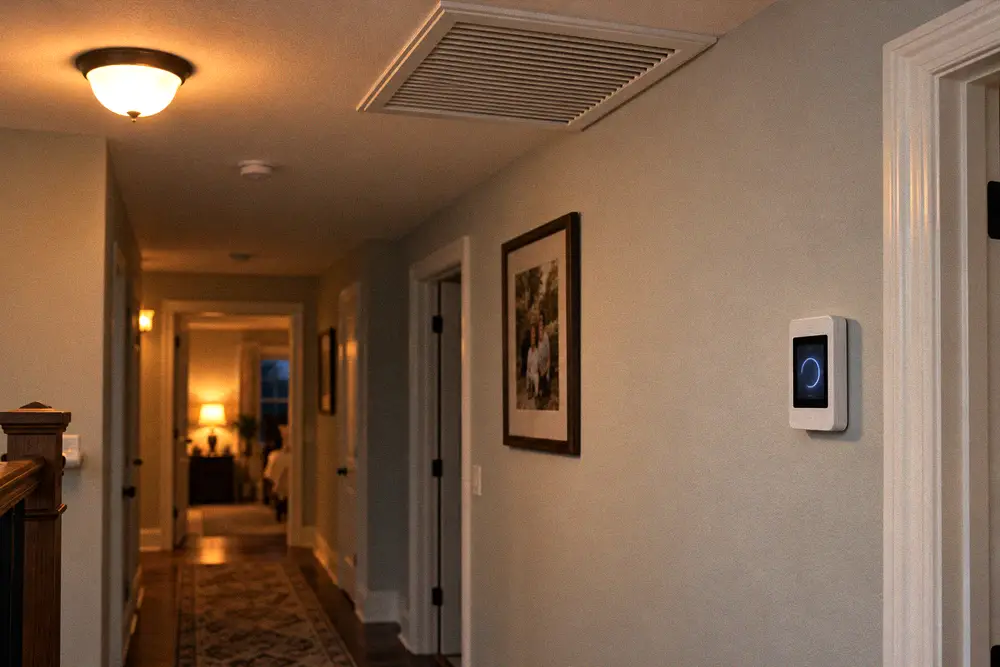
What you should know as a homeowner comes down to three things. Let a certified technician trained on A2L refrigerants handle all refrigerant work. Never bypass or ignore a leak sensor. And if your thermostat ever shows a refrigerant leak alert, treat it like a smoke alarm: follow it and call for service.
What Does the A2L Classification Mean?
This is the first question on AAON's own explainer, and it's the right place to start. The classification comes from ASHRAE Standard 34, the standard behind ASHRAE's refrigerant designations. Each refrigerant gets a two-part safety group:
- The letter is toxicity. "A" means lower toxicity; "B" means higher toxicity. Home air conditioning refrigerants, including R454B, are all in the A group.
- The number is flammability. Class 1 shows no flame propagation. Class 2 is flammable, and class 3 is highly flammable.
- The "L" is a subclass of 2. ASHRAE's addendum that created it defines class 2L as lower-flammability refrigerants with a maximum burning velocity of 10 cm/s or less. That's the speed a flame front travels through the refrigerant-air mix. The same document lists R32 at about 6.7 cm/s as a reference refrigerant.
A burning velocity that low means that even under ideal lab conditions, a flame moves through the gas slowly. For comparison, the class 3 refrigerants used in some small appliances, like propane (R290), are highly flammable and fall in a different category.
"Mildly flammable" is the industry's plain-English shorthand for A2L. It's accurate: R454B isn't nonflammable like older refrigerants, but it's a long way from propane or natural gas.
How Flammable Is R454B, Really?
Two properties answer that better than any label.
It needs a lot of it in the air to burn at all. Chemours' Opteon XL41 (R454B) product information lists a lower flammability limit (LFL) of 11.5% by volume. The LFL is the minimum concentration in air that can support a flame. Below it, the mixture simply can't burn. For R454B, more than a ninth of the air in a space would have to be refrigerant, which is a very large amount for a home system's charge to produce in any normally sized room.
It's hard to light and slow to burn. AAON, a manufacturer that builds R454B equipment, describes it this way: a substantial effort is needed to initiate ignition and to sustain combustion, and in the unlikely event of ignition the refrigerant is likely to burn slowly and self-extinguish. AAON also notes that the allowable concentration of R454B is almost 10 times higher than that of propane.
Put together, a fire risk needs three things to happen at once: a significant leak, refrigerant collecting to above 11.5% of the air in a space, and an ignition source strong enough to light it. The equipment design and installation rules exist to stop the second one from happening.
Why New Home Systems Use R454B at All
If R410A isn't flammable, why switch to something that is? The reason is climate regulation, not performance.
EPA's Technology Transitions restrictions set a global warming potential (GWP) limit of 700 for new residential air conditioning and heat pump systems. R410A is far above that limit. Chemours lists R454B's GWP at 466 in the same Opteon product sheet, so it qualifies. R454B is a blend of 68.9% R32 and 31.1% R1234yf. Nearly every refrigerant that can do this job at a GWP under 700 has some flammability, so the industry and safety standards were built around A2L refrigerants rather than avoiding them.
For the regulatory background, see which refrigerants are being phased down in the United States. For when these changes reached home equipment, see the residential air conditioner refrigerant timeline.
How R454B Compares With Other Home Refrigerants
| Refrigerant | ASHRAE safety group | Where you'll find it at home | What that means for you |
|---|---|---|---|
| R22 | A1 | Older central systems | Nonflammable; no longer produced |
| R410A | A1 | Most systems installed roughly 2010–2024 | Nonflammable; high GWP |
| R454B | A2L | Many new central ACs and heat pumps | Mildly flammable; built-in safeguards |
| R32 | A2L | Ductless, window, and some ducted units | Mildly flammable; same safety approach |
| R290 (propane) | A3 | Some newer window and portable units | Highly flammable; very small charges only |
Safety groups per ASHRAE Standard 34. Where each refrigerant appears is typical, not universal; check your unit's data plate.
If you're not sure which refrigerant your system uses, the outdoor unit's data plate lists it. Recommended refrigerants by air conditioner age gives the likely answer from the installation year.
What Safety Measures Are Built Into R454B Equipment?
That's AAON's second heading, and the answer is where the real protection lies. R454B isn't simply dropped into old designs. It's allowed only in equipment that meets specific requirements.
A federal safety standard as a condition of use
When EPA approved R454B, R32, and similar refrigerants for home air conditioning, it made safety standards a condition. EPA's SNAP Rule 23 says these refrigerants may be used only in air conditioning equipment that meets all requirements of UL Standard 60335-2-40 (3rd edition, dated November 1, 2019). The same rule requires permanent warning markings on the equipment, and red markings on pipes, hoses, and service ports that carry the refrigerant. That's how any technician who opens the system knows immediately that it contains a flammable refrigerant.
Charge limits tied to room size
UL 60335-2-40 limits how much refrigerant a system may hold relative to the size of the space it serves. UL explains that refrigerant detection systems are required when a unit's charge exceeds a limit based on the occupied room volume, with a safety factor of 4 built in. In practice, installers have to check the manufacturer's minimum room-area tables, especially for equipment in small closets, basements, and attics.
Refrigerant detection systems
Above that charge limit, the equipment carries a refrigerant detection system (RDS), a leak sensor wired into the controls. ACHR News, reporting on how manufacturers are implementing refrigerant detection systems for A2L leaks, quoted one manufacturer: any air handler, furnace coil, or packaged unit with 4 or more pounds of refrigerant must have an RDS. That covers most central systems in homes.
How the Leak Sensor Works
A refrigerant leak sensor sits at the low point of the indoor unit. ACHR describes manufacturers mounting it on or near the coil drain pan, because leaking refrigerant is heavier than air and pools low. The sensor continuously samples the air around the coil.
UL's requirements set the response threshold well below danger. The sensor must trigger a system response when refrigerant reaches 25% of the lower flammability limit, and do so within 60 seconds. For R454B, that's roughly a quarter of the way to a concentration that could even support a flame. When it triggers, UL says the system activates the evaporator fan (the indoor blower) to disperse and dilute the refrigerant with circulating air.
Manufacturers add their own steps. ACHR reports that on Daikin systems, the controls signal the outdoor unit to shut off the compressor and the flow of refrigerant. Carrier's communicating systems show a notification on the thermostat telling the homeowner to contact a service provider, and optional audible alarms are available.
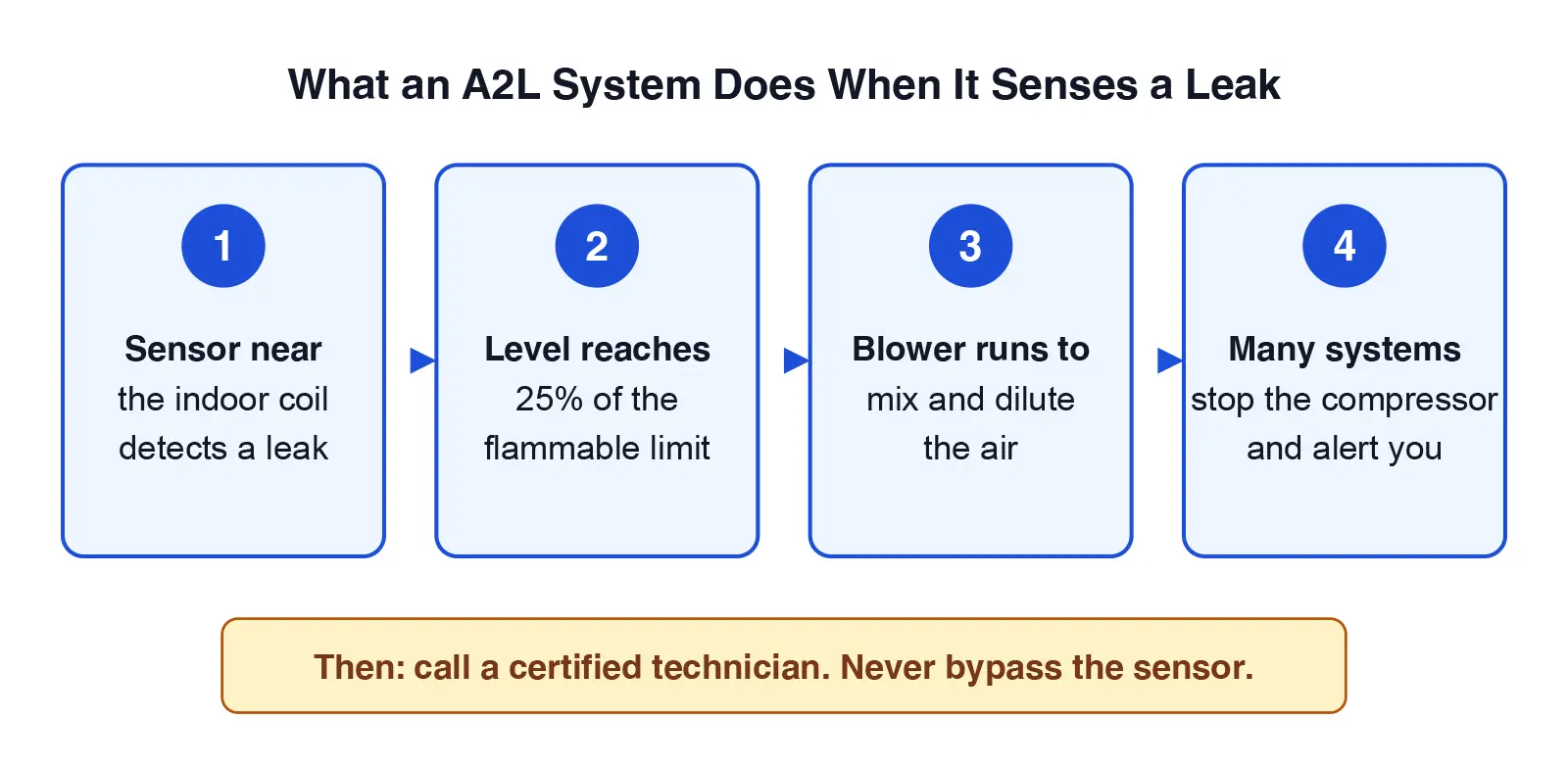
The logic is simple: find the leak early, keep the air moving so the refrigerant can't concentrate, stop feeding more refrigerant into the leak, and tell someone. Every step works to keep the refrigerant far below the level where it could ignite.
What to Do If Your Thermostat Shows a Refrigerant Leak Alert
Few homeowners will ever see this alert, but it helps to know in advance what to do.
| What you notice | What it usually means | What to do |
|---|---|---|
| Leak alert on the thermostat, blower running | Sensor detected refrigerant; mitigation active | Let the blower run; call a technician |
| Cooling or heating stopped with an alert | Controls shut the compressor off | Don't reset it repeatedly; schedule service |
| Alert after recent painting, sealing, or construction | Possibly fumes affecting the sensor | Ventilate, and still have it checked |
| Sensor fault or "RDS" error code | The sensor itself needs attention | Call for service; never disconnect it |
Based on UL 60335-2-40 mitigation requirements and manufacturer descriptions reported by ACHR News. Your equipment's manual takes precedence.
A few practical points:
- Let mitigation do its job. Don't switch the system off at the breaker unless your manual or a technician tells you to. The running blower is what's diluting the refrigerant.
- Keep flames and sparks away from the indoor unit until it's been checked. That's ordinary caution, and it costs nothing.
- Use your manual and the service number on the unit. Many manufacturers list specific steps for their alert codes.
- Expect the technician to locate and repair the leak, not just clear the alert. An A2L system with a leak needs the same leak search and repair as any system, done with procedures for flammable refrigerant.
False Alarms: Why a Sensor Might Trip Without a Leak
Sensors can react to things other than refrigerant. HVAC School's article on A2L refrigerant sensor false alarms from off-gassing points to construction adhesives and sealants as a known cause. The solvents they release while curing can look like refrigerant to some sensors. The article's advice is to ventilate well during and after that kind of work, to choose low-VOC products for indoor spaces, and to consider off-gassing before assuming a leak or a failed sensor.
It is also emphatic on one point: do not bypass A2L sensors, even when it seems like the only option. For homeowners, that means:
- Tell your technician about any recent renovation, caulking, flooring glue, or painting near the air handler.
- Don't let anyone disconnect, jumper, or remove the sensor to "stop the nuisance alarm." That disables the safety system the equipment was certified with.
- If false alarms keep happening, the fix is to find the cause or replace a faulty sensor with the manufacturer's part.
Is R454B Equipment Safe in a Basement, Closet, or Attic?
Yes, when it's installed to the manufacturer's instructions, and those instructions matter more than they did with R410A.
Because the charge limits in UL 60335-2-40 are tied to room volume, installation manuals for A2L equipment include minimum room-area or airflow requirements. An air handler in a tight utility closet may need a larger space, a specific connection to the rest of the house through the ductwork, or the leak detection and mitigation features already described. A basement furnace with an R454B coil on top is a common, certified setup when installed as the manual specifies.
Questions worth asking your installer:
- "Does this location meet the manufacturer's minimum room area for this charge?"
- "Does this system include a refrigerant detection sensor, and where is it?"
- "How will the thermostat tell me if it detects a leak?"
A good installer will answer these without hesitation, because they're checking the same things.
Can R454B Go Into My Existing R410A System?
No. This is one of the most important safety points for homeowners. R454B is designed for new equipment built for A2L refrigerants, with the certified components, markings, and detection features described above. An existing R410A system has none of those. Chemours says its A2L blends are intended for use in equipment specifically designed for them.
Put another way, the safety of R454B depends on the equipment built around it. Putting it into equipment that wasn't built for it removes the safeguards and leaves only the flammability. If your R410A system needs refrigerant, it gets R410A. If you're moving to R454B, it comes with a new system.
Who Can Work on an R454B System?
Only a certified technician, and ideally one trained on A2L procedures.
EPA's refrigerant sales restriction limits refrigerant purchases to Section 608 certified technicians (for stationary equipment like home systems), Section 609 technicians (for vehicles), and employers of certified technicians who provide written proof of employment. R454B is covered. A2L refrigerants also call for specific tools and practices, such as equipment rated for flammable refrigerants and careful control of ignition sources during brazing and recovery. That's why reputable contractors train their technicians specifically for A2L work.
Homeowner maintenance on an R454B system is the same as on any system: change filters, keep the outdoor unit clear, keep the area around the indoor unit uncluttered, and schedule regular professional service. Leave the refrigerant circuit, the sensor, and the controls to a professional.
Frequently Asked Questions
Is R454B flammable?
Yes, mildly. It's classified A2L, meaning lower flammability. It needs a concentration above about 11.5% of the air to burn, is hard to ignite, and burns slowly if it does ignite.
Is R454B toxic?
It's in ASHRAE's "A" group, which means lower toxicity, the same toxicity class as R410A and R22.
What happens if my R454B system leaks inside the house?
On systems with a leak sensor, the sensor triggers at 25% of the flammability limit. The blower runs to dilute the refrigerant, many systems stop the compressor, and the thermostat can alert you to call for service.
Can I turn off the leak sensor if it keeps going off?
No. The sensor is part of the equipment's safety certification. False alarms have fixable causes, such as fumes from adhesives or a faulty sensor, and a technician should diagnose them.
Is R454B more dangerous than R410A?
R410A is nonflammable and R454B is mildly flammable, so R454B equipment carries safety requirements that R410A equipment doesn't. When those requirements are met, R454B systems are certified as safe for homes.
Does every R454B system have a leak detector?
Not necessarily. It depends on the charge compared with the space served. Manufacturers report that air handlers and coils with about 4 pounds or more of refrigerant include one, which covers most central systems.
Can I put R454B in my old air conditioner?
No. R454B is only for new equipment designed for A2L refrigerants. It's not a retrofit for R410A or R22 systems.
Who should service my R454B heat pump?
A Section 608 certified technician with A2L training. Homeowners can't legally buy refrigerant for home systems, and A2L work requires specific tools and procedures.
Conclusion
R454B's "mildly flammable" label is real, but it's only half the picture. The refrigerant is hard to ignite and needs high concentrations to burn. The equipment it's used in has to meet a federal safety standard, carry flammable-refrigerant markings, respect charge limits tied to room size, and, on most central systems, include a sensor that dilutes any leak long before it matters. Your part is small: have it installed by trained professionals, never bypass the sensor, and treat a leak alert as a reason to call for service promptly.