
In most of the country, yes, with one important condition. A new R410A air conditioner or heat pump can still be installed at your home as long as every major refrigerant component in the system was manufactured or imported before January 1, 2025. The EPA had originally set January 1, 2026 as the last day to install that older equipment. In May 2026 it finalized a rule that removed the deadline, and that rule took effect on July 27, 2026. Pre-2025 R410A systems still sitting in warehouses can now be installed until the inventory runs out.
The part that hasn't changed matters just as much. Since January 1, 2025, manufacturers have been barred from building or importing new residential R410A systems, and that ban still stands. Every R410A system available for installation today is old stock, and the supply only shrinks. Some states also set their own rules. New York, for example, kept its January 1, 2026 cutoff. And if your existing R410A system needs a new outdoor unit or compressor, that counts as a repair under a different set of rules, and repairs remain allowed.
The rest of this article covers what changed and when, what "all components before 2025" means in practice, how to check a unit you've been quoted, where state rules can still block an install, how long R410A refrigerant is likely to stay available for service, and how an old-stock R410A system compares with a new R454B or R32 system for a household deciding right now.
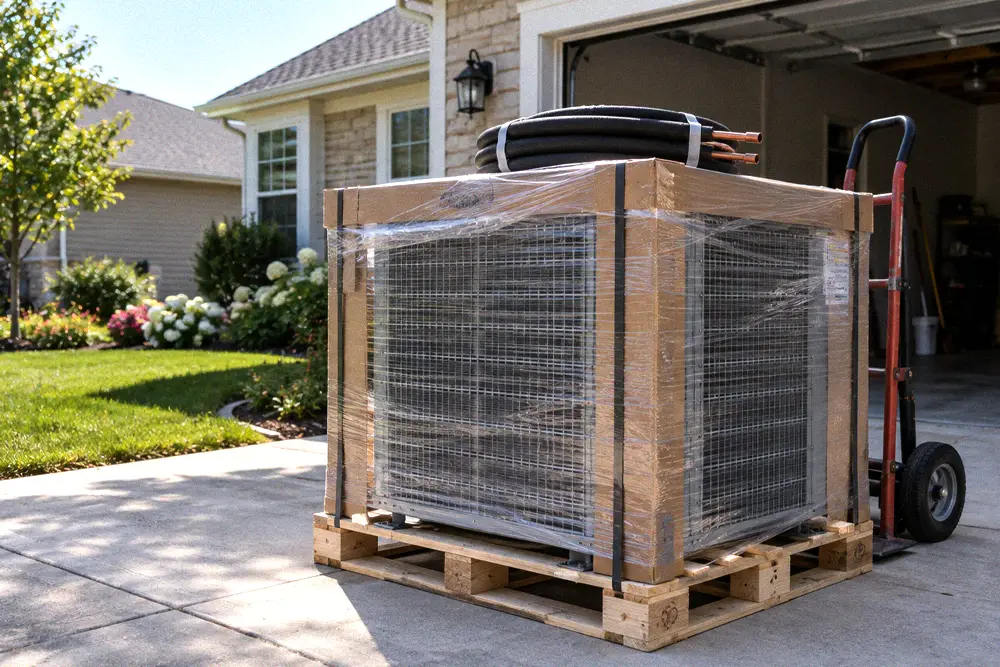
What the "2026 EPA Change" Actually Was
Most confusion about R410A comes from mixing up three separate dates. Two of them come from EPA's 2023 Technology Transitions rule under the AIM Act, the 2020 federal law that phases down hydrofluorocarbon (HFC) refrigerants. The third comes from the 2026 revision.
The 2023 rule, published in the Federal Register in December 2023, restricted new residential and light commercial air conditioning and heat pump systems that use a refrigerant with a global warming potential (GWP) of 700 or greater, starting January 1, 2025. R410A is far above that line. The same rule allowed systems whose specified components were all made or imported before January 1, 2025 to be installed only before January 1, 2026. That second date is the "2026 deadline" homeowners kept hearing about.
The deadline was then revisited. In December 2025, EPA told the industry that enforcing the January 1, 2026 installation deadline would be a low priority while it reconsidered the rule. ACCA covered this in its report on EPA's enforcement discretion for R-410A installations. In May 2026 the reconsideration became final. The rule published in the Federal Register on May 26, 2026, Phasedown of Hydrofluorocarbons: Reconsideration of Certain Regulatory Requirements, removes the installation deadline for residential and light commercial systems whose specified components were all made or imported before January 1, 2025. It took effect July 27, 2026.
| Date | What happened | What it means at home |
|---|---|---|
| January 1, 2025 | Manufacture and import of new residential AC and heat pump systems at 700+ GWP restricted | No newly built R410A systems; manufacturers move to lower-GWP refrigerants |
| December 23, 2025 | EPA calls enforcement of the installation deadline a low priority during reconsideration | Installers keep working through old stock while the rule is revised |
| January 1, 2026 | Original last day to install pre-2025 R410A systems | The date most older articles still describe as the cutoff |
| May 26, 2026 | Final rule removing that installation deadline published | Pre-2025 systems can be installed while inventory lasts |
| July 27, 2026 | Final rule takes effect | The federal installation deadline for qualifying systems no longer exists |
Sources: Federal Register (December 26, 2023 and May 26, 2026); ACCA coverage of EPA's December 2025 enforcement announcement.
If an article or a salesperson tells you R410A installs became illegal on January 1, 2026, the information was accurate for a few months and is out of date now. For how the transition fits into the longer history of home cooling refrigerants, see the residential air conditioner refrigerant timeline.
Can You Install R410A Equipment in 2026? What the Final Rule Allows
That exact question appears in the FAQ of several ranking pages, and the precise answer depends on where the equipment came from.
Under the final rule, a new R410A system can be installed at your home if all of its specified components were domestically manufactured or imported before January 1, 2025. There is no longer a federal date after which those systems become uninstallable. ACHR News summed up the practical effect in its report that EPA removed the R-410A installation deadline: contractors and distributors can keep installing existing pre-2025 inventory until supplies are depleted.
The final rule does not make R410A equipment new again. The January 1, 2025 manufacturing and import restriction is untouched. No factory is building new residential R410A systems for the U.S. market, and none can be imported. What's available is whatever was built before 2025 and never sold. It sits in distributor warehouses, on contractor shelves, and with liquidators. Once a model or size sells out, it won't be restocked.
For a homeowner, that has three consequences:
- Availability is uneven. The size, efficiency tier, or matching indoor coil your house needs may no longer exist in pre-2025 stock, even if other R410A systems do.
- The equipment has been sitting. A system made in 2024 and installed in late 2026 may have spent two years in a warehouse. Storage conditions, packaging, and warranty terms deserve a question before you sign (more on this below).
- Your installer has to verify it. A legal installation depends on manufacture dates, and the contractor installing it is the one who should confirm them.
What Counts as a "System": The Specified-Components Rule
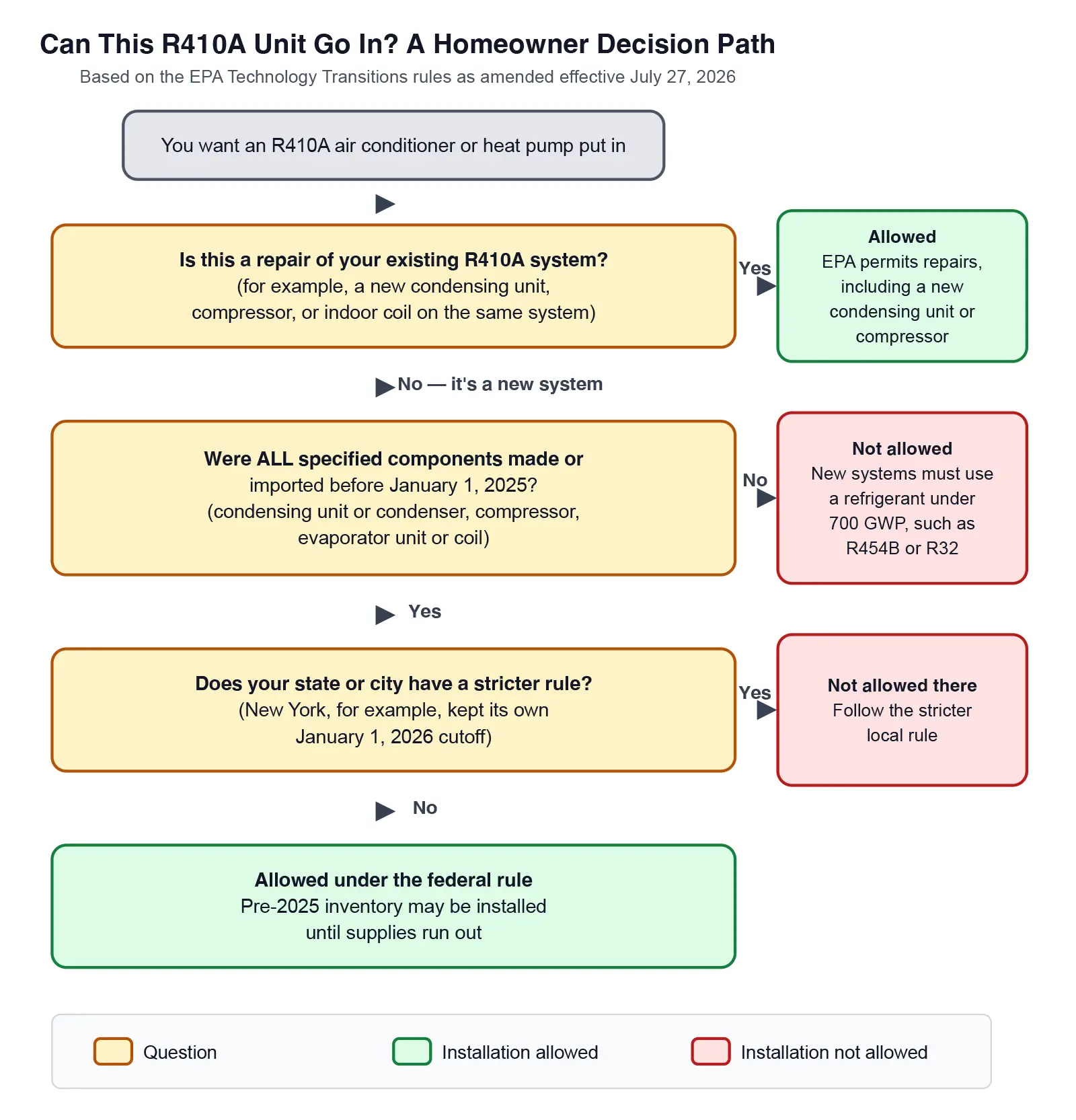
The rule doesn't ask whether the outdoor unit is old enough. It asks whether all of the system's specified components are. The 2023 rule defines specified components for these systems as condensing units, condensers, compressors, evaporator units, and evaporators. In a typical split system, that means:
- The outdoor condensing unit, which contains the compressor and condenser coil
- The indoor evaporator coil, the refrigerant coil in the air handler or furnace plenum, or the indoor unit itself in a ductless or packaged setup
Parts like the line set (the copper pipes running between indoor and outdoor units), valves, the thermostat, and the furnace are not specified components. Their manufacture dates don't decide whether the system is legal.
This matters most with matched systems. A new outdoor unit is normally paired with a new indoor coil that the manufacturer has rated to work with it. If a contractor pairs a 2024 R410A condensing unit with an indoor coil manufactured in 2025, the system doesn't meet the "all components before 2025" condition. The rule removed the deadline only for systems where every specified component predates 2025. It says nothing that would allow mixing old and new components into a new installation.
How to Check Whether a Unit You've Been Quoted Qualifies
You don't need to become a regulatory expert. A few specific questions, asked before you sign, cover almost everything.
- Ask which refrigerant the quoted system uses. It will be printed on the outdoor unit's data plate and in the product literature. If it says R410A, the rest of this list applies.
- Ask for the manufacture dates of the outdoor unit and the indoor coil. Many manufacturers print a manufacture date on the data plate or encode it in the serial number, and the installer can confirm it with the manufacturer or distributor. Both dates need to fall before January 1, 2025.
- Ask whether the pair is a manufacturer-matched combination. A rated match protects efficiency and, often, warranty coverage. A mismatched old-stock pairing is a red flag on both counts.
- Ask whether your state or city has its own refrigerant rules. The installer should know, and the next section explains why it matters.
- Get the equipment details in writing. Model and serial numbers on the invoice make any later warranty or compliance question far easier to settle.
The decision path below lays out the same logic, from "is this a repair?" through to where state rules can override the federal answer.
Repairing Your Existing R410A System Is a Different Question
Many homeowners searching this topic don't want a new system. They want to know whether their current R410A system can be fixed. The answer is simpler: yes.
EPA's frequently asked questions on the HFC phasedown states that there are no requirements to stop using equipment currently in use, and that you can continue to repair an existing air conditioning or heat pump system. That explicitly includes replacing a major component like a condensing unit or compressor. It also says new components may keep being manufactured and imported so existing systems can be maintained for their useful life. The 2026 final rule restates the same point: the original rule did not prohibit the sale and distribution of components needed to repair existing systems.
The practical difference:
- A repair keeps your existing R410A system running. That can mean a new compressor, a new coil, or even a new outdoor unit attached to your existing system. It is allowed, and replacement parts can be new production.
- A new installation is a complete new system, for example in a new home or when both indoor and outdoor equipment are replaced together. It is allowed with R410A only if all specified components predate 2025.
Your existing R410A system also won't become "illegal next year," which is another question on the ranking pages. Nothing in the federal rules requires you to remove or replace working R410A equipment.
The harder question is whether to repair or replace. For older systems, that decision usually turns on the age of the equipment, the cost of the repair, and what refrigerant supply will look like during the years you plan to keep it. If you're not sure where your system falls, recommended refrigerants by air conditioner age maps installation years to what those systems typically run on.
State and Local Rules Can Still Say No
The May 2026 rule changed federal requirements only. States with their own HFC regulations aren't bound by it, and at least one kept the original date.
The National Association of Home Builders, in its summary of EPA's final R-410A rule, notes that New York codified the original January 1, 2026 deadline in state law, meaning no R410A systems can be installed there. ACCA's reporting on the enforcement discretion reached the same conclusion about New York's rule (6 NYCRR Part 494).
If you live in New York, the answer to this article's title is no for new R410A systems, even pre-2025 stock. If you live elsewhere, ask your installer whether any state or local rule applies. Contractors who hold state licenses are expected to know. Building permits can surface the issue too, so a reputable installer who pulls the permit is part of your protection.
How Long Is R410A Going to Be Available?
This question sits under every R410A decision. A system is only as serviceable as its refrigerant supply, and that supply is shrinking on a fixed federal schedule.
The AIM Act phasedown caps HFC production and import against a historic baseline. EPA's phasedown FAQ lists the steps:
| Years | HFC supply allowed (share of baseline) | What a homeowner may notice |
|---|---|---|
| 2024–2028 | 60% | R410A still widely used for service; supply tighter than before 2024 |
| 2029–2033 | 30% | A much larger cut; reclaimed refrigerant becomes more important |
| 2034–2035 | 20% | Service supply for older systems increasingly limited |
| 2036 onward | 15% | Final step of the federal phasedown |
Source: EPA, Frequent Questions on the Phasedown of Hydrofluorocarbons. The phasedown covers HFCs overall, not R410A alone. How that cap splits across individual refrigerants depends on the market.
The phasedown schedule is separate from the installation rule, and the 2026 revision didn't change it. That's why industry groups weren't unanimous about the change. AHRI president Stephen Yurek, quoted by ACHR News, warned that extending the deadline keeps demand for existing refrigerants high while supply continues to fall. Every old-stock R410A system installed today will need R410A for any future repair that involves the refrigerant circuit.
That doesn't make an R410A system unserviceable. EPA is explicit that existing equipment can be kept running for its useful life. What it means is that over a 15-year service life, a system installed in 2026 lives through the deepest cuts in the phasedown. If you keep an R410A system, you can still get it serviced. A certified technician can confirm current availability and cylinder sizes across refrigerants carried by Freon Shop before ordering for your repair. The earlier the supply question is part of your repair-or-replace thinking, the fewer surprises later.
Should You Buy R410A Equipment Now or Wait for Low-GWP Alternatives?
This is one of the most-searched forms of the question, and it's a household decision with trade-offs on both sides. The main alternatives in new residential equipment use R454B or R32. EPA lists both as acceptable, subject to use conditions, for new residential and light commercial air conditioning and heat pumps.
| Option | Why households choose it | What to weigh |
|---|---|---|
| Pre-2025 R410A system (old stock) | Familiar technology; may be offered at clearance pricing; installers know it well | Limited sizes; long shelf time; future service depends on a shrinking refrigerant supply; not allowed in some states |
| New R454B system | Current production from major U.S. manufacturers; pressures close to R410A | Mildly flammable (A2L), so the equipment includes added safety features; typically priced as new current-generation equipment |
| New R32 system | Common in ductless mini-splits and some ducted equipment; single-component refrigerant | Also A2L; availability varies by brand and system type in your area |
| Repair the existing R410A system | Lowest upfront cost when the rest of the system is sound | Makes most sense on younger systems; repeated refrigerant repairs point toward replacement |
The A2L label comes from ASHRAE's refrigerant safety classification system. "A" means lower toxicity, and "2L" means lower flammability. Equipment built for these refrigerants is designed and installed with that in mind, which is part of why new A2L systems can cost more than clearance R410A stock.
A few rules of thumb:
- If your system is young and the failure is a repairable part, repairing usually beats replacing, whatever the refrigerant.
- If you're replacing everything and plan to stay in the house a long time, a new R454B or R32 system lines up with where parts, refrigerant, and technician training are heading. A pre-2025 R410A system can still make sense if the price difference is large and the equipment checks out, but you're buying into a refrigerant whose supply falls throughout the system's life.
- If you plan to sell within a few years, ask how the choice might look to a buyer's home inspector. Newer-refrigerant equipment is simpler to explain.
Can I Retrofit My R410A System With R454B or R32?
No. This comes up in search results often enough to answer directly. An R410A system can't be converted to R454B or R32 by swapping refrigerants. The newer refrigerants are A2L, and equipment built for them includes design and safety features that R410A equipment doesn't have. Chemours' handling bulletin for Opteon XL41 (R454B) states that these refrigerants are intended for equipment specifically designed for them. R454B is positioned for new equipment designs, not as a retrofit fluid.
Mixing is never an option either. Adding a different refrigerant to an R410A system creates a mixture no chart or technician can properly service. If your R410A system is failing and you want a lower-GWP refrigerant, the route is a new R454B or R32 system. For why these refrigerants aren't interchangeable at the equipment level, and how the broader phasedown shapes the choice, see which refrigerants are being phased down in the United States.
Warranty, Parts, and Paperwork to Ask About Before You Sign
Old-stock equipment raises questions a brand-new model doesn't. None of these are reasons to refuse an R410A quote, but each should get a clear answer.
- Warranty start date and coverage. Ask whether the manufacturer's warranty on pre-2025 equipment starts at installation or at manufacture, whether registration is required, and what it covers. Get the answer in writing.
- Storage and condition. Equipment that sat for a long time should arrive sealed, undamaged, and with its holding charge or nitrogen intact as shipped. Ask what the installer checks before installing it.
- Matched indoor coil. Confirm the indoor coil is a pre-2025, manufacturer-matched partner for the outdoor unit. This affects both legality and efficiency.
- Permits and inspection. A permitted installation leaves a record, and inspectors in states with their own rules will look at refrigerant type.
- Labor warranty. The installer's workmanship guarantee is separate from the manufacturer's equipment warranty. Ask about both.
A contractor who answers these questions easily is usually the one you want doing the work.
What Homeowners Can and Can't Do Themselves
Whatever you choose, the refrigerant work belongs to certified professionals, and federal rules say so directly.
The EPA's refrigerant sales restriction limits refrigerant purchases to Section 608 certified technicians (for stationary equipment such as home air conditioners), Section 609 certified technicians (for motor vehicle air conditioning), and employers of certified technicians who provide written evidence of that employment. It covers R410A, R454B, and R32. The only consumer exception is small cans for DIY car air conditioning, which doesn't apply to home systems.
You can:
- read the refrigerant type off your outdoor unit's data plate
- ask for manufacture dates, model numbers, and serial numbers in writing
- confirm permits and state rules with the installer
- keep your filter changed and the outdoor coil clear so whichever system you have runs well
The refrigerant circuit belongs to a certified technician: installing, charging, recovering, and repairing it.
Frequently Asked Questions
Is R410A banned in 2026?
Not in the sense most people mean. Manufacturing and importing new residential R410A systems has been prohibited since January 1, 2025. Existing R410A systems can still be operated and repaired, and under the rule effective July 27, 2026, pre-2025 R410A systems can still be installed at the federal level.
Can you install R410A equipment in 2026?
Yes, if every specified component (condensing unit, compressor, condenser, evaporator unit or coil) was manufactured or imported before January 1, 2025, and no stricter state or local rule applies.
Will my R410A system be illegal next year?
No. No federal rule requires you to stop using or replace working R410A equipment. EPA says existing systems can be used and repaired for their useful life.
Can I replace just the outdoor unit on my R410A system?
Yes. EPA treats that as a repair, and its phasedown FAQ specifically mentions replacing a condensing unit or compressor on an existing system as allowed.
What if my contractor's R410A condenser was made in 2024 but the coil was made in 2025?
For a new installation, that combination doesn't meet the "all specified components before January 1, 2025" condition. Ask for a pre-2025 matched coil or consider a new-refrigerant system.
Can I still get an R410A system installed in New York?
Not a new one. New York kept the January 1, 2026 deadline in state law, so the federal change doesn't apply there. Repairs to existing systems are a separate question; confirm the details with a New York-licensed contractor.
How long will R410A refrigerant be available for repairs?
It will stay available, but on a shrinking supply. The federal HFC phasedown steps from 60% of baseline through 2028 down to 30% from 2029, 20% from 2034, and 15% from 2036 onward. Reclaimed refrigerant will play a growing role in servicing older systems.
Can I convert my R410A system to R454B or R32?
No. Those refrigerants are designed for new equipment built for them. The only way to switch refrigerants is a new system.
Conclusion
The 2026 EPA change reopened a door that was supposed to close. A pre-2025 R410A system can still be installed in most of the United States, and nothing forces you to replace or stop repairing the R410A system you already have. The door opens only onto a shrinking warehouse, though. No new R410A residential systems are being built, every specified component has to predate 2025, some states still say no, and refrigerant supply keeps falling on a schedule the 2026 rule didn't change.
For your household, the decision comes down to three questions: is this a repair or a new system, does the quoted equipment actually qualify, and how long do you plan to live with it? Answer those with your installer, and whichever system you choose will be legal and suited to your home.