
Published: August 31, 2026
For many approved commercial refrigeration conversions, R449A can deliver cooling capacity reasonably close to R404A while reducing refrigerant GWP and potentially lowering energy consumption. However, R449A has substantially more temperature glide and may produce higher compressor discharge temperatures.
That means R449A is not a refrigerant that should simply be added to an R404A system.
The practical verdict is:
- R404A remains the straightforward service refrigerant for existing R404A equipment that has not been approved for conversion.
- R449A is often the stronger performance and environmental choice for a properly evaluated retrofit.
- Neither refrigerant is the universal long-term answer for every new commercial refrigeration system.
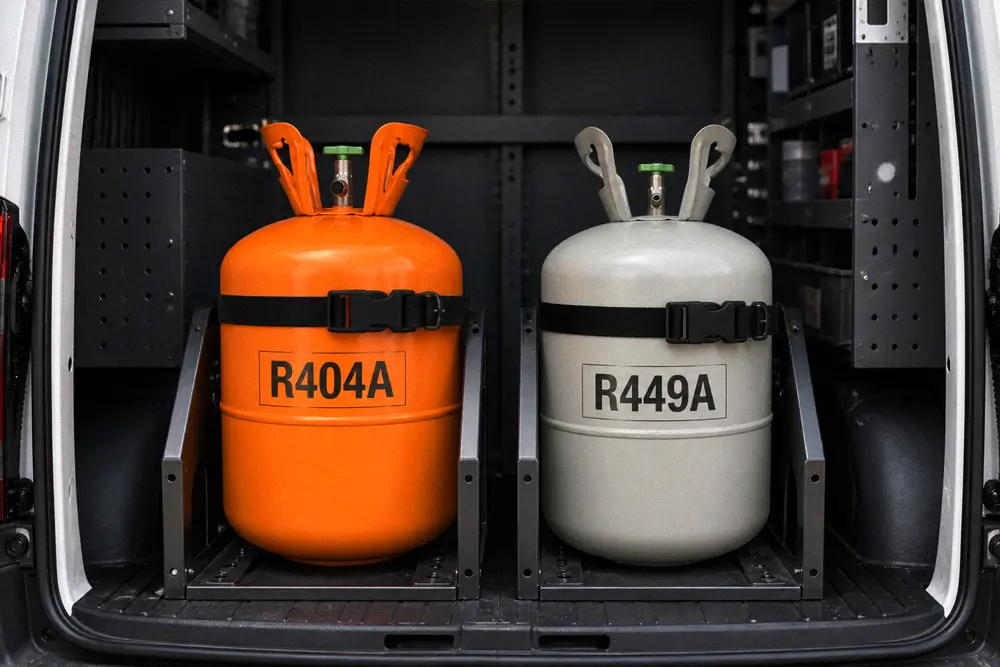
R404A vs R449A at a Glance
| Performance factor | R404A | R449A |
|---|---|---|
| Typical role | Service of compatible legacy equipment | Approved low- and medium-temperature retrofits |
| Cooling capacity | Established system-design baseline | Generally similar, with application-dependent differences |
| Energy use | Reliable but typically less favorable in optimized comparisons | May reduce energy use when properly commissioned |
| Temperature glide | Low | Approximately 4 K under commonly cited conditions |
| Discharge temperature | Generally lower under comparable low-temperature conditions | Can be materially higher, requiring compressor verification |
| EPA regulatory GWP | 3,922 | 1,396 |
| Safety classification | A1 | A1 |
Source note: GWP values come from the EPA Technology Transitions GWP Reference Table. R404A property information is supported by Honeywell’s Genetron 404A technical page, while R449A performance information is based on Chemours and equipment-manufacturer guidance.
Cooling Capacity: Is R449A as Strong as R404A?
R404A became a common commercial refrigeration refrigerant partly because it provides dependable capacity across many low- and medium-temperature applications. Compressors, valves, controls, and heat exchangers in legacy equipment were often selected using R404A performance data.
R449A was designed to provide a close enough capacity match for many compatible R404A and R507A systems. Chemours describes R449A as offering similar capacity in approved retrofit applications.
“Similar” does not mean identical. The actual comparison changes with:
- Evaporating temperature
- Condensing temperature
- Compressor model and displacement
- Suction superheat
- Liquid subcooling
- Expansion-device selection
- Condenser airflow
- Refrigerant charge
- Product and infiltration load
- Defrost strategy
A medium-temperature system may respond differently from a freezer operating at a much lower suction condition. Capacity should therefore be compared using approved compressor data at the actual design point—not by assuming that similar suction pressure means identical performance.
Which Refrigerant Wins on Capacity?
There is no universal capacity winner.
R404A has the advantage when the system remains in its original design configuration. R449A can deliver a close performance match after an approved conversion, but the expansion valve, controls, refrigerant charge, and compressor envelope may require adjustment.
If a converted system loses capacity, possible causes include:
- Incorrect controller refrigerant selection
- Expansion-valve underfeeding
- Incorrect superheat calculation
- Insufficient refrigerant charge
- Uncorrected pressure-control settings
- Excessive discharge temperature
- Condenser limitations
- Failure to account for R449A mass-flow characteristics
The refrigerant should not be blamed until commissioning errors and equipment conditions have been eliminated.
Energy Use: Can R449A Lower Electricity Consumption?
R449A often has the efficiency advantage, but the savings are not automatic.
Chemours reports that R449A can provide approximately 8% to 12% better energy efficiency than R404A or R507A in selected applications and field evaluations. A Chemours Raley’s Supermarket case history documented operation before and after an R404A-to-R449A conversion under comparable ambient conditions.
Those manufacturer results should be treated as examples, not a guaranteed savings percentage. Danfoss advises that capacity and efficiency after an R404A-to-R449A conversion depend on the system design, operating conditions, and post-retrofit setup.
A successful energy comparison requires more than reviewing one utility bill. Contractors should compare:
- Similar outdoor temperatures
- Similar store or product loads
- Compressor run hours
- Compressor amperage
- Suction and discharge pressures
- Condensing-temperature control
- Case and room temperatures
- Defrost frequency
- Door and infiltration conditions
- Fan operation
- Refrigeration energy, separated from lighting and HVAC where possible

Why R449A May Use Less Energy
Potential efficiency improvements can come from differences in thermodynamic properties and how the refrigerant performs across changing ambient conditions.
However, a conversion can fail to produce savings if:
- Head-pressure controls remain configured for R404A.
- The expansion valve is not adjusted.
- Superheat or subcooling is calculated incorrectly.
- The system is undercharged or overcharged.
- Condenser airflow is poor.
- The compressor operates outside its optimal envelope.
- Discharge-temperature protection causes excessive cycling.
- The refrigerated enclosure has uncontrolled infiltration.
R449A creates an opportunity for improved efficiency. Proper commissioning determines whether that opportunity becomes a measurable result.
Temperature Glide: The Largest Service Difference
Temperature glide is where R404A and R449A differ most clearly.
R404A is a near-azeotropic blend with relatively low glide. Its dew and bubble saturation temperatures are close enough that technicians may not notice much separation during ordinary service.
R449A is a zeotropic blend with more pronounced glide. Chemours technical materials commonly identify a glide of approximately 4 K, or about 7°F, under stated conditions. The precise value changes with pressure and the definition used.
Technicians must use:
- Dew-point temperature for evaporator superheat
- Bubble-point temperature for condenser subcooling
Using the dew temperature for subcooling or the bubble temperature for superheat can create a substantial measurement error. That error may lead a technician to add or remove refrigerant unnecessarily.
Temperature glide also means that refrigerant temperature changes as R449A travels through an evaporator or condenser. Depending on heat-exchanger design and airflow direction, the glide may influence:
- Evaporator temperature distribution
- Product-temperature consistency
- Expansion-valve response
- Defrost behavior
- Condenser approach
- Control-sensor placement
- Heat-exchanger capacity
For technicians familiar with R404A, the main adjustment is procedural: every pressure reading must be interpreted using R449A-specific dew, bubble, or midpoint data appropriate to the measurement.
Discharge Temperature and Compressor Protection
R449A can produce higher compressor discharge temperatures than R404A, especially in low-temperature applications.
This difference can narrow the safe operating envelope. Copeland technical guidance identifies liquid or vapor injection as necessary for specified low-temperature compressor applications using R449A to keep discharge-gas temperature within safe limits.
Before conversion, the contractor should verify:
- Compressor approval for R449A
- Operating envelope at the required suction and condensing conditions
- Discharge-line temperature limit
- Required liquid- or vapor-injection equipment
- Existing injection-valve condition
- Discharge-temperature thermostat compatibility
- Oil type and viscosity
- Oil-return performance
- Condenser capacity at peak ambient temperature
High discharge temperature should not be addressed merely by adding more refrigerant. The root cause may involve superheat, operating envelope, condenser conditions, compressor cooling, or incorrect system configuration.
Pressure, Mass Flow, and Expansion Devices
R449A pressures are close enough to R404A to make it a practical retrofit candidate for many systems, but their pressure-temperature relationships are not identical.
R449A also has different mass-flow and density characteristics. As a result:
- A thermostatic expansion valve may require adjustment.
- An electronic expansion valve requires the correct refrigerant profile.
- Distributor and nozzle performance should be checked.
- Solenoid and check-valve capacity may need review.
- Pressure controls and alarms may need to be reset.
- Existing piping should be evaluated for capacity and oil return.
A system that reaches temperature is not necessarily fully commissioned. Stable superheat, subcooling, discharge temperature, oil return, compressor current, and cycling behavior should all be verified.
Is R449A a Drop-In Replacement for R404A?
No. R449A is better described as a retrofit refrigerant for approved systems.
A responsible conversion generally includes:
-
Confirming equipment and compressor approval.
-
Recording stable R404A baseline measurements.
-
Recovering the complete R404A charge.
-
Repairing known leaks.
-
Checking POE lubricant condition and approval.
-
Replacing the filter-drier when required.
-
Inspecting seals and elastomeric components.
-
Evaluating the expansion device and refrigerant distributor.
-
Evacuating the system after service work.
-
Charging R449A from the cylinder as liquid.
-
Resetting pressure controls and controller parameters.
-
Commissioning with R449A dew- and bubble-point data.
-
Monitoring discharge temperature.
-
Applying a permanent conversion label.
R404A and R449A must never be mixed. Adding R449A on top of an R404A charge creates an unknown blend and makes accurate pressure-temperature calculations, performance analysis, recovery, and future servicing more difficult.
After confirming the intended application and compatibility limits, qualified professionals can compare Freon Shop’s 24 lb R404A Refrigerant for approved legacy service with its 25 lb R449A Refrigerant for approved R449A systems or conversions. A product listing does not establish equipment compatibility.
Environmental and Regulatory Comparison
The EPA GWP reference table lists R404A at 3,922 and R449A at 1,396. On that common basis, R449A has approximately 64% lower GWP.
That is a major reduction, but R449A is still not an ultra-low-GWP refrigerant.
Current EPA Technology Transitions rules apply different limits according to the equipment subsector, system configuration, refrigerant charge, and compliance date. As of August 2026:
- R404A exceeds the 1,400 interim limit applied to specified new remote condensing units beginning July 27, 2026.
- R449A falls just below that 1,400 interim threshold.
- New cold-storage warehouse systems subject to the 700 limit cannot use either refrigerant.
- Specified new supermarket systems move to a 1,400 interim limit on January 1, 2027.
- Many affected categories move to limits of 150 or 300 in 2032, which neither R404A nor R449A meets.
The EPA’s current HFC phasedown FAQ also states that legacy R404A supermarket systems can be maintained and repaired throughout their useful life and may be retrofitted to R449A after January 1, 2027. That does not eliminate SNAP requirements, manufacturer approval, state rules, or Section 608 obligations.
Which Refrigerant Should a Contractor Choose?
| Situation | More likely choice | Reason |
|---|---|---|
| Routine repair of an unconverted R404A system | R404A | Maintains the system’s existing refrigerant configuration |
| Approved conversion of serviceable legacy equipment | R449A | Similar capacity with lower GWP and possible energy improvement |
| Compressor near its discharge-temperature limit | Further engineering review | R449A may require additional compressor cooling or protection |
| New system expected to operate beyond 2032 | Evaluate lower-GWP architecture | Neither refrigerant meets many future 150 or 300 limits |
Source note: Regulatory conclusions depend on the exact EPA subsector and project details. Always verify the current EPA HFC restrictions by sector and applicable state requirements.
For a broader decision-focused comparison, see Freon Shop’s guide to R449A vs R404A for commercial refrigeration.
Frequently Asked Questions
Does R449A cool as well as R404A?
R449A generally provides similar cooling capacity in approved low- and medium-temperature applications. Actual capacity depends on the compressor, expansion device, evaporating temperature, condensing temperature, and commissioning.
Does R449A always use less electricity?
No. Manufacturer testing and field examples show potential efficiency improvements, but savings depend on equipment condition, controls, ambient temperature, load, and conversion quality.
How much temperature glide does R449A have?
A commonly cited R449A glide is approximately 4 K, or about 7°F, although the precise value changes with pressure and measurement definition. R404A has much lower glide.
Can R449A be added to an R404A system?
No. The existing R404A must be properly recovered before an approved R449A conversion. The two refrigerants must not be mixed.
Can the existing POE oil remain?
It may be possible in an approved conversion if the POE lubricant is the correct type, clean, and in acceptable condition. The compressor and retrofit guidance must determine the answer.
Why does R449A have a higher discharge temperature?
Its thermodynamic characteristics can produce a higher discharge temperature, particularly under low evaporating conditions and high compression ratios. Compressor cooling, superheat, condenser performance, and the operating envelope must be checked.
Is R449A a permanent replacement for R404A?
R449A is better viewed as a transitional option. It can reduce GWP and support compatible legacy-equipment conversions, but it exceeds the lower limits scheduled for many new-system categories in 2032.
Final Performance Verdict
R449A is the stronger overall performer for many professionally approved R404A retrofit projects. It generally maintains comparable cooling capacity, may reduce energy use, and cuts refrigerant GWP by approximately 64% on the EPA regulatory basis.
R404A still has an important service role. If an existing R404A system has not been approved or economically justified for conversion, maintaining the original refrigerant avoids creating an unauthorized mixed or incorrectly configured system.
R449A’s advantages require more careful service practices. Its temperature glide demands correct dew- and bubble-point calculations, while its higher discharge temperature can require compressor protection or injection in low-temperature applications.
The right decision therefore depends on more than capacity alone. Contractors should evaluate operating cost, compressor approval, remaining equipment life, conversion expense, temperature control, refrigerant availability, and the regulatory limits expected throughout the system’s planned life.