
Published September 4, 2026
R448A and R449A deliver remarkably similar cooling capacity and energy efficiency in commercial refrigeration. Neither is universally the better refrigerant. R449A may provide a slightly smaller temperature glide and marginally lower compressor discharge temperature under some operating conditions, while R448A has a similarly low GWP and broad use in compatible low- and medium-temperature systems.
For most technicians, the decision should be based on compressor approval, expansion-device requirements, equipment-manufacturer guidance, local availability, and the refrigerant already specified for the system—not on an expectation of a dramatic efficiency difference.
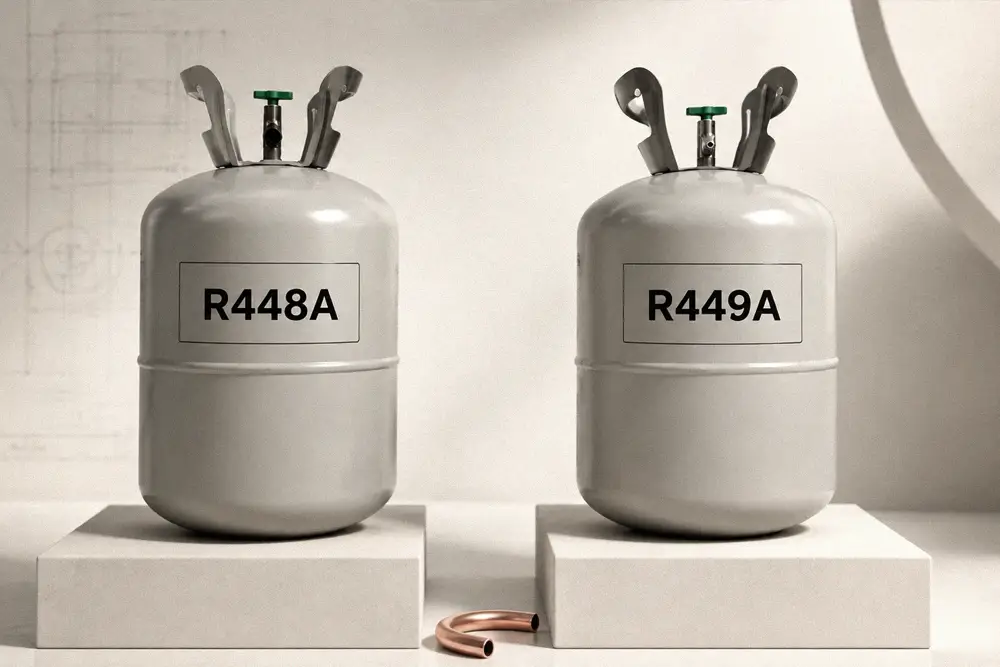
R448A vs R449A at a Glance
Both refrigerants are zeotropic HFC/HFO blends developed for compatible commercial refrigeration equipment. They are commonly evaluated when replacing higher-GWP refrigerants such as R404A or R507A, but neither should be treated as a universal drop-in substitute.
| Comparison Point | R448A | R449A |
|---|---|---|
| Typical applications | Compatible low- and medium-temperature commercial refrigeration | Compatible low- and medium-temperature commercial refrigeration |
| Safety classification | A1 | A1 |
| EPA Technology Transitions GWP | 1,386 | 1,396 |
| Blend components | R32, R125, R134a, R1234yf, R1234ze(E) | R32, R125, R134a, R1234yf |
| Cooling capacity | Very similar to R449A | Very similar to R448A |
| Energy efficiency | Comparable; system-dependent | Comparable; system-dependent |
| Temperature glide | Approximately 4 K under cited comparison conditions | Approximately 3.6 K under cited comparison conditions |
| Discharge temperature | Slightly higher in the cited comparison | Slightly lower in the cited comparison |
According to the EPA Technology Transitions GWP reference table, the regulatory GWP values used for that program are 1,386 for R448A and 1,396 for R449A. Their blend compositions are listed in the ASHRAE refrigerant designation database. Safety classification, glide, and application information comes from the Honeywell R448A technical data and Chemours R449A product literature.
GWP values can vary among documents because different IPCC assessment methodologies may be used. Compare refrigerants only when the figures come from the same stated framework.
What Do R448A and R449A Have in Common?
R448A and R449A are much more alike than their different model numbers might suggest.
Both are:
- Zeotropic refrigerant blends
- Classified A1 under ASHRAE Standard 34
- Non-ozone-depleting
- Intended for compatible low- and medium-temperature refrigeration
- Commonly evaluated for approved R404A and R507A conversions
- Normally used with POE lubricant in applicable equipment
- Subject to temperature glide
- Required to be charged from the cylinder as liquid to preserve blend composition
The largest compositional difference is that R448A contains five components, including R1234ze(E), while R449A contains four. That difference produces small changes in thermodynamic behavior, but it does not normally create a large gap in capacity or coefficient of performance.
Cooling Capacity Comparison
In properly selected equipment, R448A and R449A generally provide closely matched cooling capacity.
A Chemours comparison of R449A and R448A evaluated low- and medium-temperature operation using thermodynamic calculations and compressor-selection software. Depending on the data source and operating point, R448A capacity ranged from approximately 98% to 101% of the R449A reference value.
That narrow range means there is no defensible universal claim that one refrigerant always produces more cooling. Actual system capacity depends on factors such as:
- Evaporating and condensing temperatures
- Compressor model and operating envelope
- Suction-gas superheat
- Liquid subcooling
- Expansion-device selection
- Heat-exchanger design
- Airflow and coil cleanliness
- Refrigerant charge accuracy
- Control settings and system load
A refrigerant that performs well in simulation can still produce poor field results if the expansion valve is improperly sized, the condenser is dirty, or the compressor operates outside its approved envelope.
ALT Text: Bakery display case filled with pastries behind glass
Caption: Medium-temperature display cases require stable product temperatures, making equipment approval and correct control settings more important than a small theoretical difference between R448A and R449A.
Image source: James Collington on Pexels. Free to use under the Pexels License, including use on websites and blogs.
R448A vs R449A Energy Efficiency
Energy efficiency is also extremely close. In the same Chemours comparison, the calculated or software-derived coefficient of performance for R448A ranged from approximately 98% to 101% of the R449A baseline, depending on the modeled compressor and operating condition.
A one- or two-percentage-point modeled difference should not be interpreted as a guaranteed utility-bill saving. In real refrigeration systems, energy consumption may be affected more strongly by:
- Floating-head-pressure controls
- Compressor staging
- Evaporator fan operation
- Defrost frequency
- Door-opening patterns
- Suction pressure
- Condenser approach temperature
- Refrigerant leaks or incorrect charging
- Poorly adjusted superheat
This is why technicians should compare manufacturer selection data for the exact compressor rather than choosing solely from a general refrigerant-property chart. The Danfoss R448A and R449A compressor performance catalog, for example, publishes capacity and power data at defined evaporating and ambient temperatures instead of treating performance as a single fixed number.
Which Refrigerant Uses Less Electricity?
Neither refrigerant can be declared the efficiency winner for every installation.
R448A may produce a small advantage at one operating point or with one compressor, while R449A may equal or slightly outperform it under another set of conditions. Correct component selection, commissioning, and maintenance are more likely to determine the measured energy result.
Temperature Glide: The Most Important Service Difference
Temperature glide is the change in saturation temperature that occurs while a zeotropic refrigerant evaporates or condenses at essentially constant pressure.
Because both R448A and R449A have meaningful glide, technicians must distinguish between:
- Dew-point temperature, normally used when calculating evaporator superheat
- Bubble-point temperature, normally used when calculating condenser subcooling
- Mean temperature, often used in equipment ratings and performance comparisons
In Chemours’ defined low-temperature comparison, R449A had a glide of approximately 3.6 K, compared with 4.0 K for R448A. Under its medium-temperature comparison, the values were approximately 3.9 K and 4.3 K. These are modest differences, and glide varies with pressure and operating conditions.
R449A’s slightly smaller glide may simplify temperature interpretation in some systems, but it does not eliminate the need to use the correct pressure-temperature data.
ALT Text: Close-up of stacked metal plates inside a plate heat exchanger
Caption: Heat-exchanger design and refrigerant flow direction influence how effectively a refrigeration system manages the temperature change of a zeotropic blend.
Image source: Chris.holmes24 via Wikimedia Commons. CC0 1.0 Public Domain Dedication.
Why Glide Matters in the Field
Glide affects more than pressure-temperature chart selection. It can influence evaporator temperature distribution, condenser performance, thermostatic expansion-valve adjustment, and the interpretation of suction and liquid-line measurements.
A counterflow heat exchanger may use the changing refrigerant temperature more effectively than a less favorable flow arrangement. Circuit design and distributor performance can also affect how evenly the evaporator is fed.
Because the two refrigerants are blends, they should be removed from the supply cylinder as liquid. Vapor charging from a partially used cylinder can change the composition delivered to the system.
Compressor Discharge Temperature
R448A and R449A can both produce higher discharge temperatures than R404A in certain low-temperature applications. Compressor-envelope checks are therefore essential during a conversion.
Under the controlled conditions in Chemours’ comparison, R449A produced a calculated low-temperature discharge temperature of 118°C, while R448A produced 119.2°C. At the stated medium-temperature condition, the values were 94°C and 94.6°C.
The difference between R448A and R449A was small, but it favored R449A in that particular analysis. It should not be applied as a universal field measurement.
The broader concern is whether either refrigerant keeps the selected compressor within the manufacturer’s approved operating envelope. Depending on the system, technicians may need to evaluate:
- Liquid or vapor injection
- Demand cooling
- Return-gas temperature
- Condensing-temperature control
- Compressor cooling
- Discharge-line temperature protection
- Superheat settings
Tecumseh’s commercial refrigeration conversion guidance warns that R448A and R449A can produce higher discharge-gas and motor temperatures than R404A, particularly at low evaporating temperatures.
Can R448A and R449A Be Interchanged?
No. Similar performance does not make R448A and R449A interchangeable without an approved procedure.
They have different compositions, pressure-temperature data, and performance characteristics. A system labeled for R448A should not simply be topped off with R449A, and an R449A system should not receive R448A. Mixing the two creates an unidentified refrigerant mixture and makes future service, recovery, and performance analysis more difficult.
For approved applications, technicians can review the verified R448A refrigerant product page or R449A refrigerant product page after confirming which refrigerant the equipment and conversion documentation specify.
Retrofit Considerations
An approved R404A or R507A conversion involves more than recovering one refrigerant and adding another.
A qualified technician should normally:
- Document the original operating conditions.
- Confirm approval from the compressor and equipment manufacturers.
- Verify the compressor operating envelope.
- Recover the existing refrigerant without mixing it with another product.
- Repair known leaks.
- Check POE lubricant condition and oil return.
- Evaluate seals, controls, solenoid valves, and expansion devices.
- Evacuate the system according to the approved procedure.
- Charge the selected blend as liquid.
- Set superheat and subcooling using the correct dew and bubble data.
- Check discharge temperature and compressor current.
- Relabel the equipment with the new refrigerant and charge quantity.
- Record final operating data for future service.
The correct charge weight may differ from the former R404A charge. Technicians should begin with the manufacturer’s recommended conversion quantity and adjust using measured system performance—not by assuming the original charge transfers pound for pound.
According to the EPA Section 608 certification requirements, technicians who service equipment in ways that could release refrigerant must hold the appropriate certification. EPA service practices also prohibit intentional venting and require appropriate refrigerant recovery.
Which Refrigerant Should You Choose?
| Situation | Preferred Decision | Reason |
|---|---|---|
| Existing R448A system | Continue with R448A | Maintains the specified refrigerant and avoids mixing |
| Existing R449A system | Continue with R449A | Preserves approved components and service data |
| New equipment selection | Follow equipment specifications | Capacity and efficiency depend on the complete system design |
| Approved R404A conversion | Compare OEM-approved options | Compressor limits, valves, controls, and operating temperatures matter |
| Very low-temperature duty | Prioritize discharge-temperature control | Both blends may require compressor-temperature management |
The practical winner is usually the refrigerant already approved for the equipment and supported by the contractor’s service procedures. If both are approved, compare compressor-selection data, glide management, component availability, training, and lifecycle supply.
Qualified buyers can browse the broader Freon Shop HVAC refrigerant collection. The complete refrigerant collection is also available for other system-specific service requirements. A listed product should never be interpreted as evidence of compatibility with a particular system.
Frequently Asked Questions
Is R449A better than R448A?
Not universally. R449A showed a slightly smaller glide and slightly lower discharge temperature in one controlled manufacturer comparison. Cooling capacity and efficiency were otherwise extremely close. Equipment approval remains more important than the small theoretical difference.
Do R448A and R449A have the same pressure?
Their pressure-temperature relationships are very similar, but not identical. Technicians must use the correct chart or digital manifold setting for the refrigerant actually installed.
Can R449A be added to an R448A system?
No. Recover the existing refrigerant and follow an approved conversion procedure if a change is authorized. Never mix R448A and R449A or use one to top off a system containing the other.
Which refrigerant has the lower GWP?
Under the EPA Technology Transitions methodology, R448A has a GWP of 1,386 and R449A has a GWP of 1,396. The difference is small. Other documents may show different values when they use another IPCC assessment methodology.
Are R448A and R449A nonflammable?
Both are classified A1, meaning lower toxicity and no flame propagation under the ASHRAE classification test conditions. A1 does not eliminate other hazards: liquid refrigerant can cause frostbite, vapor can displace oxygen, and cylinders must be stored and handled correctly.
Are R448A and R449A drop-in replacements for R404A?
No. They may be approved retrofit options for certain R404A systems, but component review, recovery, evacuation, charging, adjustment, monitoring, and relabeling may be required. See the separate R449A versus R404A guide for additional background.
Final Verdict
R448A and R449A are closely matched commercial refrigeration refrigerants. Their cooling capacity and coefficient of performance are generally similar, and their EPA regulatory GWP values differ by less than one percent.
R449A may hold a small advantage in temperature glide and compressor discharge temperature under some conditions. However, those differences are usually too small to override compressor approval, equipment specifications, system design, field operating conditions, and established service practices.
For an existing system, use the refrigerant identified on the equipment label unless an approved conversion has been completed. For a planned retrofit, compare the exact compressor and component guidance, then have a properly certified refrigeration professional perform and document the work.